There are times when my Avast Home Edition Security Software seems to lock up for 3 to 5 minutes downloading the latest update or version. Although it’s not a lot of time, the repeated event grinds on my nerves. For that reason I was very pleased to read about the Yoggie Pico Security System.
The first of it’s kind, the Yoggie Pico device is a self contained mini computer on a USB stick which runs and manages 13 different security applications.
At first thought – doesn’t seem like much – why not load up 13 security applications on your computer and save a USB port? Well, the beauty lies within the combination of a self contained unit, a processor to run it self and the combination of hardware and software to protect your computer.
Continue Reading
Undoubtedly there are certain sports which carry hard-core fans. Fans who will go to any length for that one unique piece of memorabilia. Right up there with hockey and football fans are Indy Car Race fans.
Although I can’t find the press release now, today I received visual candy confirming our beloved Indianapolis Motor Speedway has officially endorsed the USB flash drive technology. Indianapolis Motor Speedway USB drive:
For just $20 you too can get this exclusive (I want to say limited edition, but not sure) Indianapolis Motor Speedway 512MB flash drive for your storage pleasure. It’s never been easier to one-up your Indy loving geek friend with this piece of sporting memorabilia.
Alan McKelvey, Retail Manager for IMS on-line stores sent me this back room photo to let the world know they mean business.
I’ve given tips on how to disable USB ports via security software or changing Windows USB register files, but the simplest way to secure a USB port is to block it.
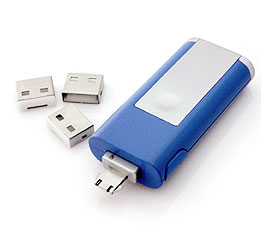
The folks at Earth-Trek developed a swanky USB lock which uses the UFD shaped key to also house the USB locks.
As you can see in the picture, the key uses a mechanical lever type setup to insert the USB lock, then detach the key from the seated lock and the USB port is blocked.
Judging by the picture it might not be hard to tear out the USB lock, but you’ll probably make enough noise in the attempt to draw attention.
PQI has a thoughtful approach to USB Readyboost. Rather then sucking up a cherished external USB port PQI is taking an internal approach. Here you see a PQI 2GB memory enhancement for Readyboost via the USB header connector on a motherboard.
Although it might not enhance the performance of your Vista system, it is a nice internal solution. Maybe PQI knew Readyboost was a bunch of marketing hype and came out the champion to support the PC monopoly all-the-while keeping the commoner happy with the same number of USB ports.
But, putting some thought into PQI’s approach there is an advantage. One interesting possibility would be if you could boot from it, as it could make for a great companion for a media center machine if you run some kind of Linux version on it, as you don’t have to waste drive space on the OS.
Continue Reading
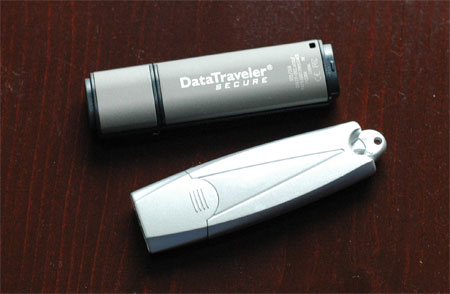
Today I found a flash drive I purchase back in January of 2004. I compared that drive performance to a brand new Kingston DataTraveler. I know the theoretical maximum transfer speed of USB 1.1 is 12Mbps per second and USB 2.0 is that of 480Mbps per second – but it’s always fun to get a real world test.
My real world test came up with the following results.
Continue Reading
Ian Murchison is an Industrial Design engineer at Carleton University in Ottawa Canada and came up with some outstanding product ideas.
Ian’s most recent design is the Video Player Slideon with USB connectivity (above). From a recent email interview Ian developed this product design from his original Slideon concept (below).
A follow up design was needed as a lot of people liked the original design, but some were also looking for a more “video player” type design.
As with the original, it’s a slider concept meaning;
Continue Reading
Rugged flash drives have been a trend these last couple months. Manufacturers see how popular flash drives continue to be and conclude a more durable version is needed for every day use. So along with the never-ending quest of more data storage, manufacturers are developing ways to make UFDs last longer and handle more abuse.
We put the question out there, “What’s the worst your flash drive went through?” and this is what we found:
It’s predictable that our most popular abuse was dropping them. Although it doesn’t sound like a much, it can be. Flash drives – well the memory in them – are sensitive and cannot take large amounts of shock. Many times dropping a drive from your table top is good enough to damage the drive.
I did find it interesting the next most frequent UFD abuse came from submersing them in water. I’ll assume in this case, the most common mistake is forgetting about the drive and accidentally washing it.
Whatever your daily routine, it’s worth taking an extra few minutes to search out the right flash drive for your habits. Rugged flash drives will become more popular as 1) materials drop in price to build a better box and 2) users continue to put more and more valuable information on their flash drives.
Continue Reading
I’m just a blogger; have written about Readyboost; but never investigated it’s performance. I found an article today from PC World who took a closer look. Basically, it blows.
“What is Readyboost you ask?” well it’s a feature of Vista that allows flash memory (like USB Sticks) to be used as additional RAM to boost PC performance.
PC World took that claim and put it to the bench. First off, Microsoft indicates that only the best performing flash drives should be used, (3.5MBs per/sec reads and 2.5MBs per/sec writes) so although some web sites claim “use any extra flash drive for Readyboost,” that claim is a bunch of BS.
Using the best performing drives from Kingston, Lexar and Ridata it was concluded the Readyboost did improve performance, but only by 4 to 6%. So unless you had a stop watch – BFD! My Vista upgrade is going to wait.
Continue Reading
The announcement of Microsoft developing a UFD platform to replace U3 could turn into a similar battle we saw 25 years ago between VHS and Betamax.
Major suppliers have already dropped the U3 platform because of high royalty fees (around 5%) to bundle less expensive software which does the same thing. As these suppliers, like Kingston and Memorex, begin to choose the alternate like Migo Software, a heated war could surface between flash drive manufacturers.
Originally SanDisk partnered with M-Systems to develop the U3 solution, but as time went on, SanDisk bought out M-Systems and the evolution of U3 continues with this most recent partnership.
Microsoft is developing the software platform and SanDisk will continue offering their hardware for a total solution (yes, it’s a hardware/software thing). In addition, SanDisk and Microsoft will bundle in the TrustedFlash security technology developed by SanDisk.
“The U3 platform was established with the vision of giving customers a consistent and portable computing experience. The existing 20,000 U3 software developers that joined us show the potential for smart flash memory devices,†said Yoram Cedar, executive vice president of the mobile business unit and corporate engineering at SanDisk.
“We expect this relationship with Microsoft will raise the overall experience for consumers given Microsoft’s unique software expertise, and grow the momentum given the large community of 3rd party companies capable of utilizing Microsoft’s technologies.â€
The migration process for the 20,000 U3 developers is a straight forward and simple one – Microsoft puts the pressure back on you to make the migration. Microsoft did say there will be tools to ad in the process, but the bottom line is U3 developers better get cracking if they want to see the light-of-day come mid 2008.
Continue Reading
We’ve seen the capacity meter before from Lexar and they’ve now officially introduces the capacity meter technology to the Secure II USB flash drive line.
The load meter doesn’t require connection to display the amount of storage left, it doesn’t require firmware and isn’t OS specific. It’s a standalone technology to communicate one simple thing and ultimately provides a little more flexibility and convenience for the user.
The Lexar Secure II ships with 256-bit AES encryption technology which lets users protect data quickly and easily. Users can easily create multiple password-protected encrypted areas and simply drag files into the secure area for automatic encryption. Drag the files out again, and they are automatically decrypted.
An excellent feature Lexar includes is their File Shredder utility that safely erases files and destroys the digital trail usually left behind with a simple file delete command. With the File Shredder whatever is deleted cannot be recovered or restored.
The JumpDrive Secure II is available now in sizes between 512MB to 8GBs.
Continue Reading
New Launches posted this old school eraser which houses a USB flash drive.
The clever design is an irony of sorts, the eraser erases your mismatched efforts while the USB Drive stores them!
The flash drive is a 1GB size and is available for about $100 USD. What is hard to get my hands around is the ability to turn anything into a flash drive these days. I did a post yesterday of the top 19 cheeziest flash drives from over seas, on top of the strange one’s I’ve reported on, like Spongebob, Pez figures and the USB bullet.
Continue Reading
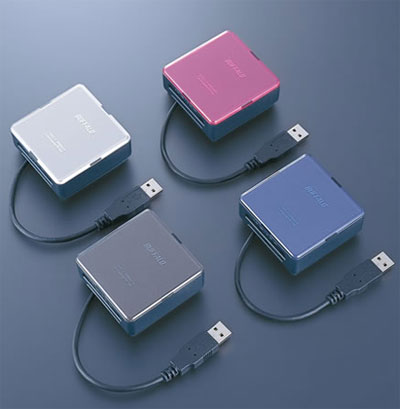
Tis the season for card readers…yesterday we had the latest from Kingston for the MobileLite announcement, now Buffalo introduces their latest line up – the MCR-A28 USB card reader.
This USB card reader supports 30 card types and most notably the new SDHC and Memory Stick Pro format – which are not backward compatible with other card readers which previously supported SD and Memory Stick.
Since the Kingston MobileLite is a 9 card reader focused on mobile memory cards, if you need something with a wider range of support YET still compact in size, the Buffalo USB card reader makes our short list.
Continue Reading