SanDisk is helping in the fight against Alzheimer’s with a specially branded USB drive and SD card. Look for the color purple which represents “Take Action Against Alzheimer’s”
SanDisk will contribute $1 for each unit sold to the Alzheimer’s Association. The products available are 2GB capacity and carry the same price tag as the regular branded drives.
SanDisk commemorative Fight For The Cause products are now available at SanDisk.com, Best Buy and other participating retailers.
SanDisk would also like to note September 21 is World Alzheimer’s Day, and you can join millions of others in the fight against Alzheimer’s disease. If you’d like to make on-line contribution today to Alzheimer’s Association, your donation will help turn $1 million into $2 million. If the Association reaches the goal of $1 million, the Harrah’s Foundation will match it — dollar for dollar. Help make a million dollar difference. Make a pledge today to FUND THE CAUSE.
To learn more about SanDisk’s fight against Alzheimer’s please visit SanDisk/alz/Continue Reading
Forget the laptop, load the flash drive with your slide show. Using the new Toshiba DLP projector (TDP-EX20U) display 60 inches of visual goodness directly from your USB drive.
Get up close and personal with those 60 inches at just 2 feet, although wear sunglass as the Toshiba projector with USB has 2,300 lumens and an awesome 2,000:1 contrast ratio.
If you missplaced your flash drive, say dropped it in the water, then connect to the DLP projector via Ethernet or Wi-Fi. The TDP-EX20U is a cool $1,600.
Source: ElectronistaContinue Reading
I don’t think anyone is tired of USB flash drives, but I’m sure there are a large group of flash memory enthusiasts that would appreciate a Firewire flash drive. Maybe MacFanBoy? Maybe someone who’s eaten up all their USB ports with silly USB gadgets.
Kanguru Solutions has a 6 pin Firewire flash drive ranging from 1GB to 8Gbs with prices ranges from $99 to $219 respectively. It’s plug-n-play with most operating systems (Win 98 will need drivers) and includes a USB cable for converter connectivity.
I’d really like to see the performance between the Fire Flash and an equally sized USB drive. I’d expect the same transfer rates – or close enough only an Ubergeek wouldn’t notice a difference.
Kanguru Fire Flash product page.
Continue Reading
Designed by Undoboy, a member of the Spear Collection, Mimobot introduces the King and Queen series.
Patterned with all the royal shapes of diamonds, hearts, clubs and spades the USB King and USB Queen collection is another unique design from Mimoco.
Included in the limited edition USB drive is a short animation, wallpapers and icons. What is odd about this release is Mimobot labeling the series as “R” and “Not For Kids” The response from Mimoco:
The content on the King and Queen units contains footage of artists using expletives, being extremely frank, etc…
As a foot note; Mimobot is running a 25% OFF back to school sale so if any of their characters where the right design, but the wrong price (like their Starwars Stormtropper or Chewbacca) – might be worth another revisit.
Source: MimocoContinue Reading
Here is a small, portable USB video and audio capture device with some decent specifications. At 720 x 480 resolution you get DVD resolution from the EasyCAP although I would think you only obtain that using S-Video rather than Composite.
ShenZhen also ships the Ulead video editing software which is user friend and ideal for someone who’s looking to take a first stab and create home videos.
NTSC format gets you 30 fps while PAL gets you 25fps, and get this; you only need 256MB of RAM to pull this off – although I would highly recommend at least 1GB of RAM when doing ANY type of video editing.
If interested go ahead and make a request to Kassy (kassy.forward< @>gmail.com) for more info. Or visit his site.
Continue Reading
It’s no secret Corsair has a ten number push button padlock for their USB flash drive, the Corsair Flash Padlock. It’s also no secret our good friends over at Gizmos for Geeks are security fanatics – Doug prides himself on having the lowdown on the lockdown.
Looking at the picture it’s very obvious what this drive is all about. In addition to any software security loaded on the drive the Flash Padlock includes a physical pin number to be associated with the drive. What I like about this drive is without the correct pin entered, Windows doesn’t even see the drive upon USB connection.
The idea behind this drive is dual authentication. 1) Something you know (PIN) and 2) Something you have (the USB drive). (The ID Vault is another product which works much the same way)
Tip: Might not want to use the same PIN number as your ATM card/machine.
Source: Gizmos for GeeksContinue Reading
A company called Suck UK is about to launch this UFD cleverly disguised as a cassette tape. Nothing more than some creative packaging. So why am I writing about this? Because the other products on their website are absolutely classic for a good laugh. Such as Suck UK’s Smoking Mittens, Razorblade Mirror, Cardboard Mini Arcade and the list wouldn’t be complete without the Emergency Money Box. More fun stuff, check them out.
As for the USB stick in a cassette box, it’s available end of September and sizes are yet to be announced. If by chance you have a library of cassette tapes needing to be digitized than check out our post from the other day on a USB Cassette Archiver.
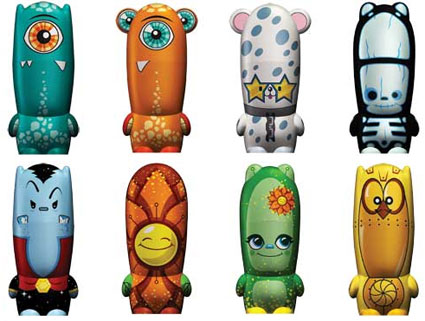
So what exactly are we looking at? Mimobot USB characters have always been a little off in their design, but I guess that’s why their following is so strong. Or is it?
Nine new models came out last week and they are strange – must be based off the characters in the animated movie, Chicken Little. So lets do a quick run-down.
Row One:
PSY mimobot
Ptry mimobot
PupStar mimobot
RayD8 mimobot
How do they come up with these names?
Row Two:
Galacula mimobot (Okay that makes sense)
Gigglebyte mimobot
Fairybit mimobot
Owsley Owlbert mimobot
The straggler Swirl mimobot.
Each Mimobot is available from 512MB to 4GB size and range in price from $40 to $110. As with most Mimobots these fun little USB characters are manufactured in only 2,000 quantity so if one strikes-your-fancy; get it!
Continue Reading
Laptops rejoice! Sewell is spinning out a very inexpensive USB to DVI adapter to offer high quality video displays for those tiny notebooks displays. The process is simple. The external DVI video unit has a USB port which you connect to your laptop (or PC) and a DVI port you connect to you external monitor, turn everything on and you’re done.
The $120 price tag might seem a couple dollars high, but considering there is 128MB of flash memory used for buffering and processing the video signal you wont be disappointed. Sewell claims the USB to DVI adapter drove a 20 inch DVI screen with no visible differences what-so-ever.
The USB bandwidth is more than enough to transfer the necessary video data to the USB to DVI adapter, and the 128 megs of onboard RAM does the rest to bring you perfect performance every time.
With this unit you can turn any laptop into a three monitor system: 1) Laptop screen, 2) use DVI output of laptop 3) use Sewell DVI adapter for monitor #3.
Source: Sewell via Slash GearContinue Reading
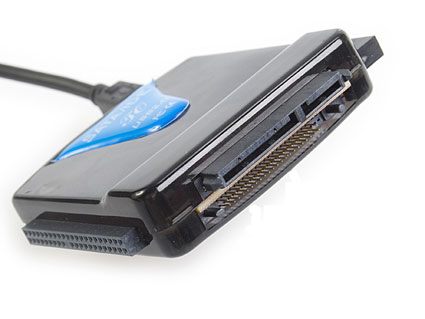
This SATA/IDE to USB converter kit would be the easiest way to clone your hard drive and finally upgrade your laptop storage space. However, the combo kit isn’t limited to just 2.5 inch hard drives but includes connection support for 1.8, 3.5 and 5.25 inch hard drives along with CD-ROM drives, CD-R, CD-RW, DVD blah blah blah – anything in 5.25 inch size.
The USB to SATA/IDE combo kit is fully compliant with USB 2.0 so you can expect maximum transfer speeds of 480Mbps (yet that never happens) and plug-n-play connectivity with hot-swap support. For the techie, the chipset used in this guy is JMicron-JM20337.
With $3 shipping for any order this converter kit to go from USB to SATA/IDE (product page) puts you back exactly $32USD. Takes about 7 days to receive anywhere in the world.
Continue Reading
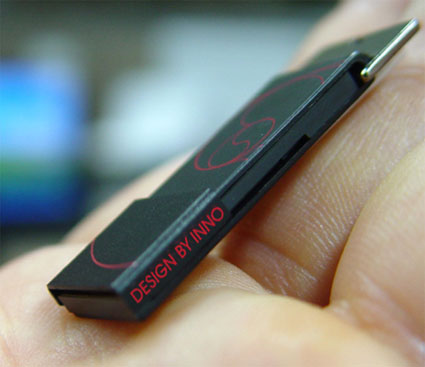
The new IOCELL UFD, the mDrive, is a slick design from the leading Korean design firm, InnoDesign. Young Kim is creating a Korean focus for this drive based off the national flag or Taeguk-ki, which emphasizes beauty and balance.
Wearing the mDrive means one has come into the deep philosophy of Taeguk and breaths the cosmos it creates.
Hmm…I know the American culture isn’t much into karma (isn’t that obvious!) but philosophy aside, this is still one slick looking flash drive. InnoDesign put specific detail into the color and lines of the drive to reflect the balance of the Korean flag. I especially like the small metal lanyard clip as it appears as durable as one would need not to lose those valuable personal files. The gold plated USB connector style also makes the drive very resilient against water damage.
This USB webcam is for the egotistical with glowing white LEDs to nail those perfect internet first impressions. Although anonymity is what most internet users strive for, if you need clear shots with bright environments the USB Big Eye does just that.
Resolution is 1280 x 960 and focal points from 5cm to infinity, built-in image compression, dynamic image e-mail and 24-bit RGB color it’s a decent USB web cam.




 Hmm…I know the American culture isn’t much into karma (isn’t that obvious!) but philosophy aside, this is still one slick looking flash drive. InnoDesign put specific detail into the color and lines of the drive to reflect the balance of the Korean flag. I especially like the small metal lanyard clip as it appears as durable as one would need not to lose those valuable personal files. The gold plated USB connector style also makes the drive very resilient against water damage.


