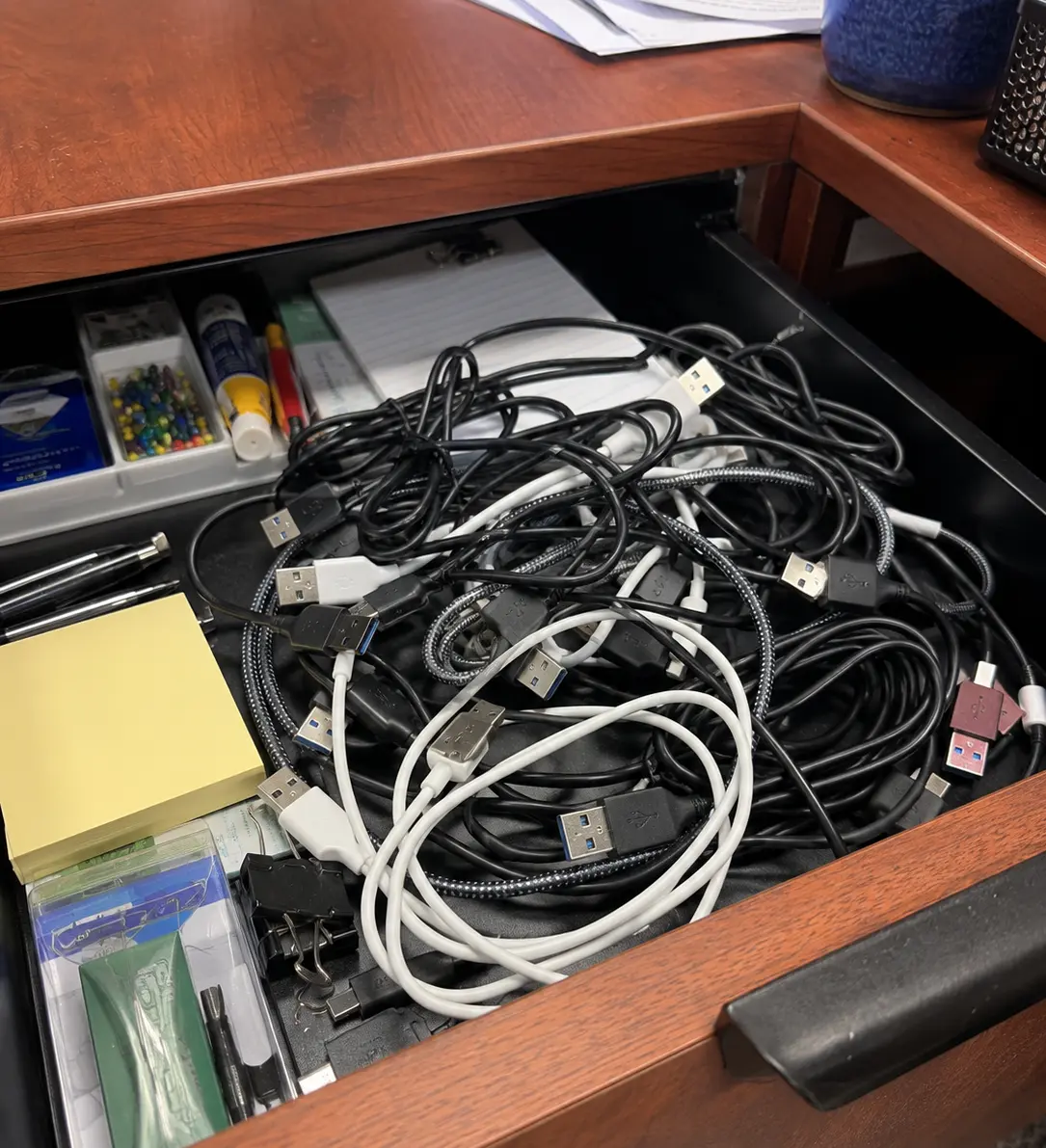
Recently, Ben Lovejoy of 9to5Mac published an article about the free Mac application WhatCable, a clever utility that reads information available from electronically marked USB-C cables and presents it in an easy-to-understand format. For anyone with a drawer full of nearly identical USB-C cables, the software can quickly identify charging capabilities, supported data rates, USB specifications, and other characteristics that would otherwise remain hidden from the user.
While reading the article, one sentence immediately stood out.
Near the end of the review, Lovejoy notes that the application does not work perfectly because some cables can lie about their capabilities.
Although that comment was only a brief observation about USB-C cables, it highlights a much larger engineering concept that applies to virtually every USB device on the market. Whether the hardware is a USB-C cable, flash drive, SSD, or even a USB hub, there is an important distinction between what a device reports about itself and what independent testing proves it can actually do.
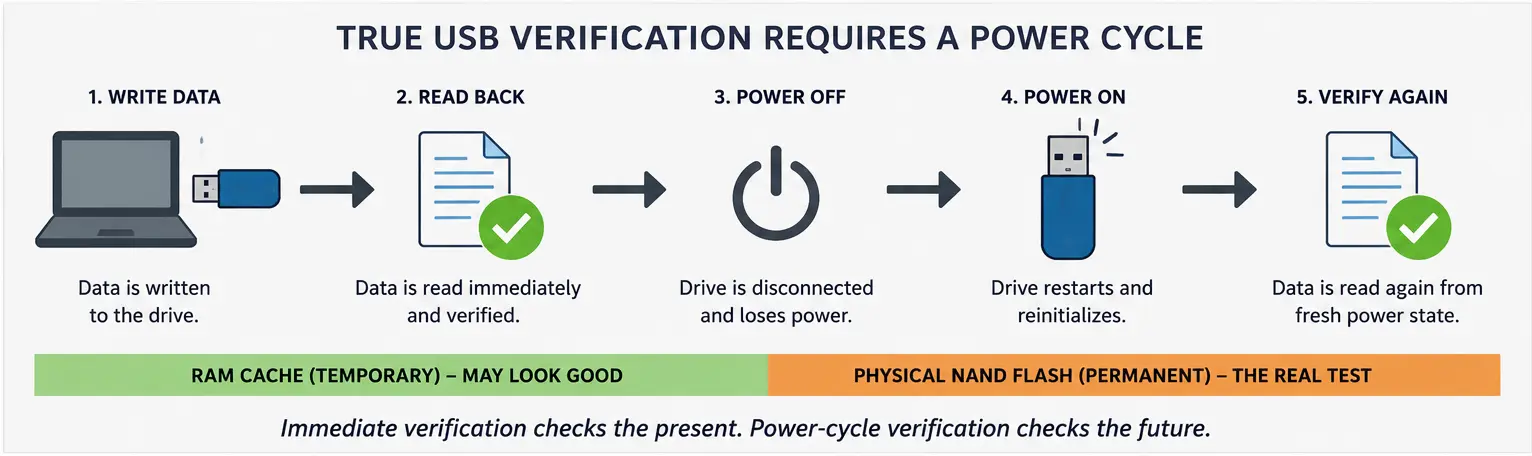
For readers who recently saw our discussion about USB data verification and why power cycling matters, the underlying principle is remarkably similar.
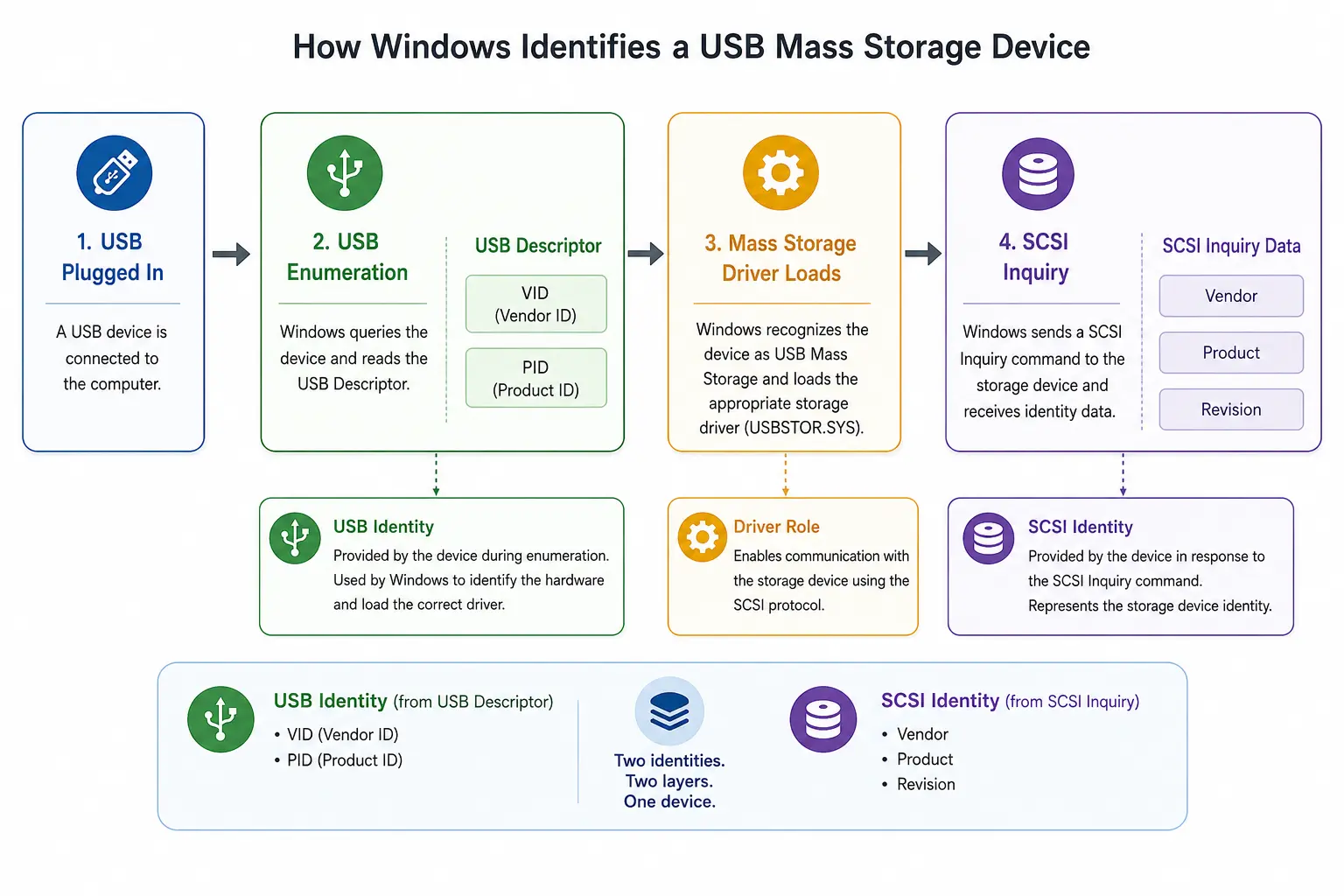
Modern USB devices constantly advertise information about themselves. A USB-C cable may contain an eMarker chipA chip embedded in USB-C cables that reports cable capabilities such as charging current, data rates, and vendor information. that identifies supported charging current, data rates, and vendor information. Flash drives report their storage capacity, USB version, and manufacturer identification. SSDs maintain SMART information describing drive health, remaining life, and operating temperature. In each of these examples, the host computer is not independently measuring every reported characteristic. Instead, it is displaying information supplied by the device itself.
In the overwhelming majority of cases, that information is accurate. However, engineering has repeatedly shown that descriptors are not the same as verification. Counterfeit flash drives have long reported capacities far larger than the physical NAND memory installed. USB-C cables occasionally advertise performance levels they cannot consistently sustain under real-world operating conditions. Storage devices may report excellent health while intermittent failures begin developing under heavy workloads. The descriptors themselves are not necessarily incorrect; they simply represent what the controller believes, or what it has been programmed to report.
This is precisely why the discussion surrounding power-cycle verification is so interesting. An immediate verification confirms that data can be read successfully immediately after it has been written. A power cycle asks a different question: after the controller has completely shut down, restarted, and rebuilt its internal state, does the data still exist exactly as expected? The distinction is subtle, but important. One validates a successful transaction, while the other provides a stronger test of whether the data truly persisted after the device restarted.
None of this should be interpreted as criticism of the WhatCable application. In fact, it appears to do exactly what it was designed to do. Presenting cable capabilities in plain English is far more useful than expecting users to decode USB Power Delivery descriptors or eMarker data manually. The application simply illustrates an engineering reality that has existed for decades: software can only report what the hardware makes available. If the information supplied by the hardware is incomplete or inaccurate, software cannot independently correct every limitation.
The larger lesson is that USB descriptors, SMART data, cable identification, and device enumeration should all be viewed as valuable pieces of information, but not as absolute proof of performance or reliability. They represent the beginning of an evaluation rather than its conclusion. Whether the objective is validating a high-speed USB-C cable or confirming the integrity of duplicated flash media, meaningful testing still requires observing how the hardware behaves under actual operating conditions. In engineering, there is a significant difference between a device describing its capabilities and a device consistently demonstrating them.
Let GetUSB.info keep you updated.
Receive article notifications about USB storage, flash memory, and duplication updates in your preferred language. We average a couple of articles per week.