How To Read and Write CID on SD Cards
If you are looking to read the CID number of an SD card, or extract the CID off an SD card, then you will find this article very helpful. Some also call this “reading the PSN off the SD card” or reading the product serial number off the SD card.
UPDATE (Feb 16, 2023):
We learned the company which manufactures this product now offers the ability to write the CID value as well as write protect the Secure Digital media.
Most phones and much of the software on phones will lock into the CID number of an SD card. The CID number is a unique card identifier number that is unique to the card itself. The CID number is valuable because software developers and hardware developers can lock software to the unique number of the device, thus eliminating the ability to pass along licensed software.
Reading the CID number from an SD card is not an easy task. It requires specific access codes to the index table of the memory card, and unless you know how to use the SD chipset of your card reader, chances are you won’t get the number—or at least not the correct and accurate number.
What is the CID number of an SD card?
The CID register is 16 bytes long and contains a unique card identification number. It is programmed during card manufacturing and cannot be changed by SD Card hosts. The CID number is a compilation of information about the card, such as manufacturer, date manufactured, checksum total, GB size, and more. Below is a table outlining all the items which make up the SD CID number.

So with all this said, how do you read the CID number from an SD card? As we’ve mentioned, it isn’t easy and it’s hardware based. If you do enough searching on the internet, you’ll find some home-brew code to read the CID numbers, but that’s only if you have the SD card or microSD card connected via an IDE bus to your host computer. This isn’t easy for everyone. There is clear evidence that using a USB to SD card reader will not get you the information you require—or at least accurate and correct information. Meaning most times the CID number generated is actually the serial number of the card reader itself, not the CID number of a specific SD card.
In addition, what if you are required to read the CID number off SD media in bulk? A single, one-at-a-time solution is not practical.
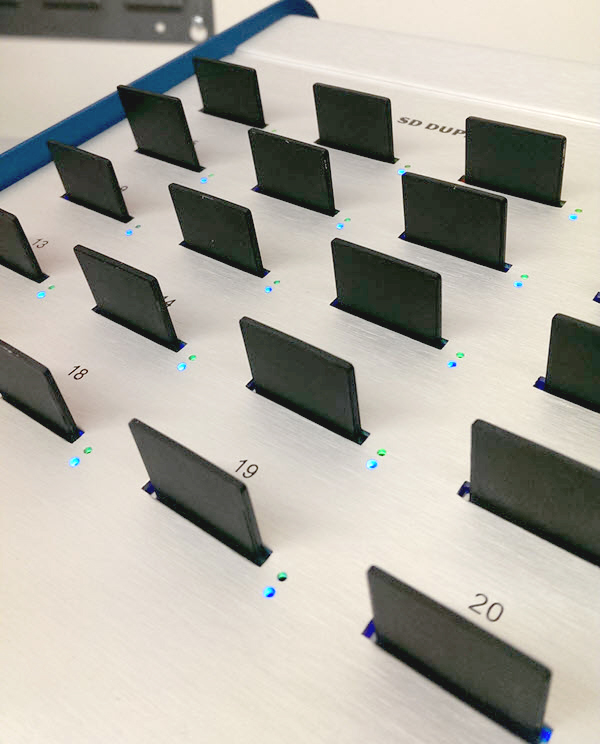
In my search to read the CID number from SD media, I came across Nexcopy – a manufacturer of USB duplicator equipment and other flash memory equipment. Several models they carry are SD duplicators and microSD duplicators. With the secure digital duplicators, part of their feature set includes reading CID numbers from SD media. The equipment can read 20 cards at a time, 40 cards at a time, or 60 cards at a time, depending on the model. The duplicators will read the CID number and export it to a .csv file for import into other business functions. This configuration makes it quick and easy to obtain the CID number. Granted, the equipment is not designed for single-use operation, but rather reading the CID of SD media in bulk quantity. Here is a screenshot of Nexcopy’s software reading 20 CID numbers:

I didn’t contact Nexcopy Incorporated for pricing of the equipment, but doing a quick search for the equipment shows me a price of about $1k for the smallest 20 target system and $3k for the largest 60 target system.
With all this said, there is still no clear-cut method to read CID numbers off SD cards for the home-user, but maybe this article will at least explain why you haven’t found a good solution as of yet.
The CID (Card Identification) number is a unique identifier that is assigned to each Secure Digital (SD) card. The CID number is a 16-byte value that is used by the SD card host device to identify the SD card and to determine its capabilities.


 DELL, so it is said, started a new code project call Ophelia. The project is turning a USB key into a portable desktop. The USB would have the ability to access online software tools and operating systems. The USB solution from Ophelia will still require a hardware setup (someone’s PC) so think of it as a USB stick high-jacking the processor, RAM, motherboard, video controller etc to run it’s own OS.
We’ve seen things like this from smaller, start-up companies, but DELL has the ability to really make this main stream. The rumor on target price is $50 US Dollars.
I for one believe the ability to high-jack another PCs hardware doesn’t warrant it enough to be more then a complimentary tool to one’s main PC. Now if DELL can high-jack the
Continue Reading
DELL, so it is said, started a new code project call Ophelia. The project is turning a USB key into a portable desktop. The USB would have the ability to access online software tools and operating systems. The USB solution from Ophelia will still require a hardware setup (someone’s PC) so think of it as a USB stick high-jacking the processor, RAM, motherboard, video controller etc to run it’s own OS.
We’ve seen things like this from smaller, start-up companies, but DELL has the ability to really make this main stream. The rumor on target price is $50 US Dollars.
I for one believe the ability to high-jack another PCs hardware doesn’t warrant it enough to be more then a complimentary tool to one’s main PC. Now if DELL can high-jack the
Continue Reading

 Read up on the tutorial via
  The idea is putting a controller chip embedded between several pieces of paper. From there, USB contacts are created to transmit the electical current of the four pins required to make USB work.
Granted, this wont be an 8GB flash drive, but you can autorun a website, store some basic information or embed music for an audible greeting card.
The ideas do seem limitless when you watch the video off the start-up webpage at
The idea is putting a controller chip embedded between several pieces of paper. From there, USB contacts are created to transmit the electical current of the four pins required to make USB work.
Granted, this wont be an 8GB flash drive, but you can autorun a website, store some basic information or embed music for an audible greeting card.
The ideas do seem limitless when you watch the video off the start-up webpage at 
 Rich click that bad boy and select the Show Package Contents form the pop-up.
Navigate to Contents > SharedSupport and then start looking for the InstallESD.dmg. This is the image file for the installer.
Now we need to launch the DiskUtility so open a new folder with Command N.
Rich click that bad boy and select the Show Package Contents form the pop-up.
Navigate to Contents > SharedSupport and then start looking for the InstallESD.dmg. This is the image file for the installer.
Now we need to launch the DiskUtility so open a new folder with Command N.
 Items you will need:
 Using tape to secure the lead start of the yarn, start wrapping
 How about taking the slingshot in the game and making it real life? This is exactly what this DIY hacker did.
Over at
How about taking the slingshot in the game and making it real life? This is exactly what this DIY hacker did.
Over at  Scientists are trying to break the boundaries of Moore’s law by taking a phosphorus atom and create a working transistor as the gate to control electrical flow.
Moore’s law describes a long-term trend in the history of computer manufacturing whereby the number of transistors that can be placed in the same amount of space doubles approximately every two years.
Michelle Simmons, director of ARC Center for Quantum Computation and Communication Technology at the University of New South Wales, Australia, took an atom and etched it into a silicon bed with “gates” to control electrical flow and metallic contacts to apply voltage to start/stop current. It’s the first such device to be precisely positioned using
Scientists are trying to break the boundaries of Moore’s law by taking a phosphorus atom and create a working transistor as the gate to control electrical flow.
Moore’s law describes a long-term trend in the history of computer manufacturing whereby the number of transistors that can be placed in the same amount of space doubles approximately every two years.
Michelle Simmons, director of ARC Center for Quantum Computation and Communication Technology at the University of New South Wales, Australia, took an atom and etched it into a silicon bed with “gates” to control electrical flow and metallic contacts to apply voltage to start/stop current. It’s the first such device to be precisely positioned using

 Feature List includes:
All USB interface requirements
Feature List includes:
All USB interface requirements