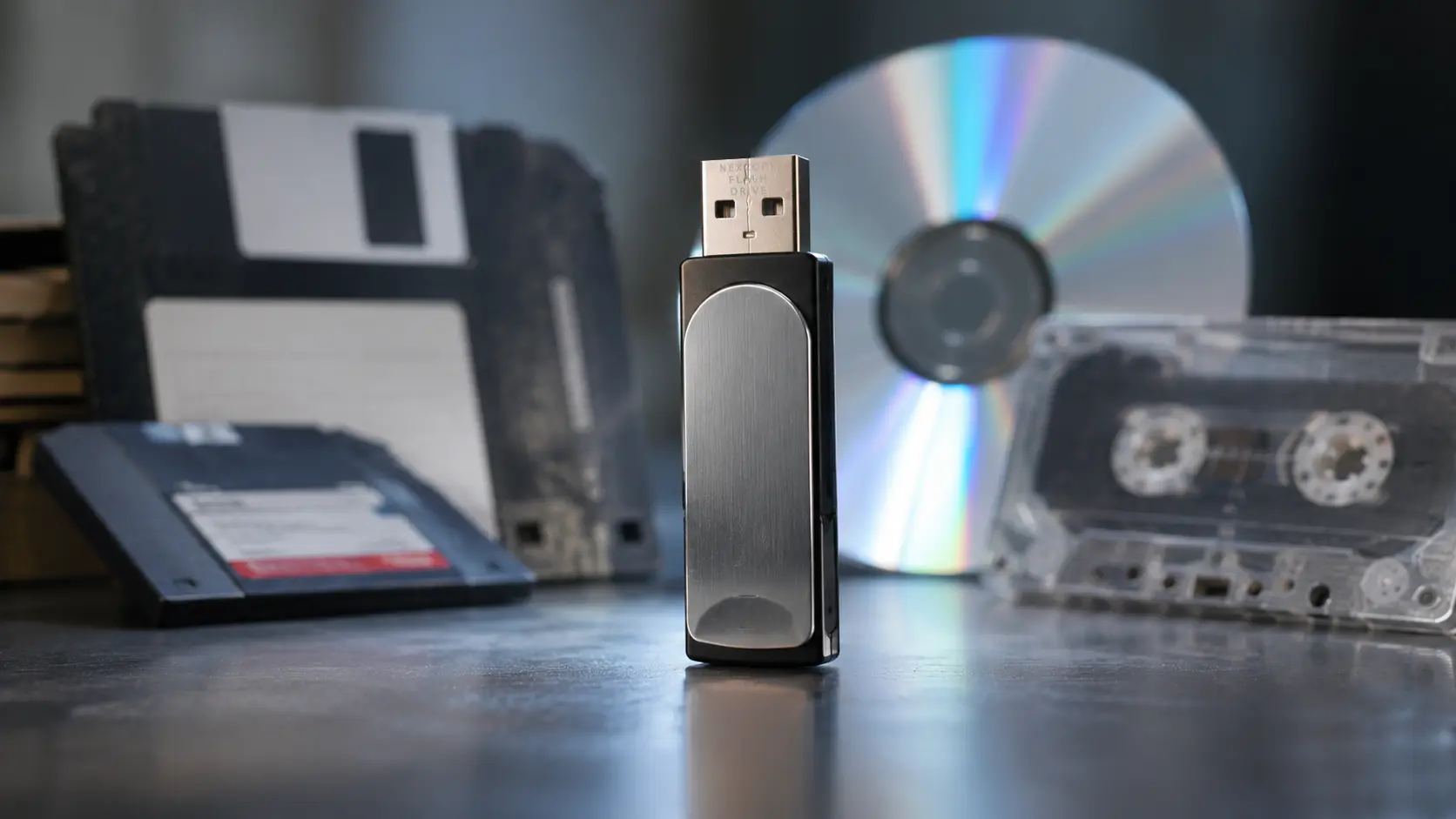
Someone recently asked me what technology I thought would replace the USB flash drive. It’s a reasonable question considering how quickly technology changes. After all, we’ve seen floppy disks disappear, optical discs become increasingly irrelevant, and entire categories of consumer electronics replaced by the smartphone. Surely the USB flash drive is somewhere on that list of technologies destined to disappear.
But the more I thought about the question, the more difficult it became to identify a suitable replacement. Not because technology has stopped advancing, but because the problem a USB flash drive solves today is somewhat different from the problem it solved twenty-five years ago.
And that distinction might be the very reason the USB flash drive sticks around for another twenty-five years.
The Internet Has Already Replaced Much of What USB Was Designed to Do
When USB flash drives became commercially available around the year 2000, their primary purpose was to move information from one computer to another. Internet connections were slow, email attachments were limited, and moving a significant amount of data electronically was often impractical.
The USB flash drive solved that problem beautifully.
Fast-forward to today, and the internet is already fast enough to handle most of our everyday data transportation needs. The underlying technology exists, and as telecommunications companies expand network capacity and make higher bandwidth available to businesses and consumers, physically transporting data becomes even less necessary.
Between cloud storage, email, file-sharing services and wireless communication, we already have the technology to replace much of the original functionality of a USB flash drive.
So why are we still using them?
Because moving information from one location to another is no longer the only reason we need portable storage.
Internet Speed Doesn’t Solve Internet Dependency
Imagine a world where everyone has unlimited internet access at gigabit speeds. No bandwidth restrictions, no slow downloads and no waiting for files to upload.
Would that eliminate the need for a USB flash drive?
Probably not.
Having a faster internet connection doesn’t solve the problem of needing an internet connection in the first place. It doesn’t solve the problem of a cloud service going offline, an account being suspended, a software company going out of business or a subscription becoming too expensive.
There is also a fundamental difference between having access to your information and physically possessing a copy of your information.
Consider a family with twenty years of photographs stored through an online service. They might have access to every photograph within seconds, but that access is dependent upon an account, an internet connection and the continued operation of somebody else’s computer system.
Having an additional copy of those photographs on a physical storage device changes that relationship. The family no longer relies exclusively on another company to access its own memories.
This isn’t an argument against cloud storage. Cloud storage is incredibly convenient and serves an important purpose. Rather, it’s an argument for maintaining a level of independence from the infrastructure we increasingly rely upon.
Could Cybersecurity Actually Extend the Life of the USB Flash Drive?
There is a certain irony in the relationship between internet technology and the USB flash drive. The very connectivity that was supposed to make portable storage obsolete may be creating one of the strongest arguments for keeping it around.
As computers, servers and backup systems become increasingly interconnected, they also become more accessible to cyberattacks. Ransomware is a particularly good example because attackers often attempt to destroy or encrypt backup files in addition to the original data.
A USB flash drive sitting in a desk drawer, physically disconnected from a computer, cannot be reached remotely by ransomware. It doesn’t have an IP address, isn’t listening for instructions and doesn’t have an online account that can be compromised.
The Cybersecurity and Infrastructure Security Agency (CISA) specifically recommends maintaining offline, encrypted backups of critical information and regularly testing those backups as part of a ransomware prevention and recovery strategy.
Of course, this doesn’t mean a USB flash drive is inherently secure, nor should a single flash drive be the only backup of important information. Physical storage devices can fail, become lost or introduce malware when connected to an infected computer.
However, the ability to physically disconnect information from a network is a valuable characteristic that no improvement in internet speed can replicate.
Sometimes the simplest solution to a sophisticated technology problem is to disconnect it.
There Is an Entire World of Technology That Doesn’t Need the Internet
When discussing the future of technology, we tend to think about smartphones, laptops and the consumer electronics we use every day. What we often overlook is the enormous amount of technology operating behind the scenes.
Manufacturing equipment, medical devices, CNC machines, scientific instruments, military equipment and industrial control systems all have legitimate reasons for using removable storage.
Consider a manufacturing facility with a million-dollar piece of equipment that has an expected operational life of twenty years. The manufacturer doesn’t necessarily want that equipment dependent upon an internet connection, a cloud service or an operating system that requires constant updates.
If an operator needs to load a new configuration file or retrieve production information, a USB flash drive might be the most practical solution, provided its use is permitted and properly controlled.
The same logic applies to equipment that operates in remote locations or environments where internet connectivity is deliberately restricted.
These applications don’t necessarily need a faster or more sophisticated storage technology. They need something predictable, compatible, inexpensive and independent.
What Technology Could Replace the USB Flash Drive?
Looking at the next five years, there are several technologies that could potentially reduce our reliance on USB flash drives. However, each comes with its own set of compromises.
Smartphones: Almost everyone carries a smartphone with a significant amount of storage capacity. In theory, the smartphone could function as a universal portable storage device. In practice, operating system restrictions, security permissions, battery requirements and device compatibility make this considerably less straightforward than plugging in a flash drive.
Peer-to-peer wireless communication: Technologies such as Wi-Fi Direct allow devices to transfer information without necessarily requiring an internet connection. However, both devices must be powered, support compatible communication protocols and have appropriate software. Wireless communication is an excellent alternative for transferring information, but it isn’t necessarily a replacement for physically removable storage.
SD and microSD cards: These technologies already offer an extremely compact alternative to the USB flash drive. Newer specifications, such as SD Express, provide impressive performance. The fundamental disadvantage is the requirement for a compatible card reader, something that is becoming less common on general-purpose computers.
Portable solid-state drives: Perhaps the most logical successor to the traditional USB flash drive is the miniature portable SSD. These devices offer higher performance and substantial storage capacity in an increasingly small package. However, most portable SSDs still connect through USB. At what point does a miniature portable SSD simply become a more sophisticated USB flash drive?
Emerging storage technologies: Research into DNA storage and specially engineered glass storage is fascinating, particularly because of the potential for preserving enormous amounts of information for extended periods. However, these technologies are primarily being developed for archival applications. They are unlikely to become inexpensive, pocket-sized, reusable consumer storage devices within the next five years.
What becomes apparent is that we have plenty of technologies capable of replacing individual characteristics of the USB flash drive, but very few capable of replacing all of them simultaneously.
The Remarkable Simplicity of the USB Flash Drive
Take a moment to consider what a conventional USB flash drive actually provides.
- No battery to charge.
- No internet connection required.
- No subscription fees.
- No account registration.
- No wireless pairing or configuration.
- Broad operating system compatibility.
- Low manufacturing cost.
- Physical possession and transportation of information.
- Easy physical disconnection from a computer or network.
We tend to take these characteristics for granted because USB flash drives have been around for so long.
However, imagine you were given the task of developing a new technology today that had to meet every one of those requirements. You might find yourself designing something remarkably similar to a USB flash drive.
There is also something to be said about the absence of complexity. Every additional dependency introduced into a technology creates another potential point of failure.
A battery can discharge. A wireless connection can fail. A password can be forgotten. A subscription can expire. A server can go offline.
An ordinary USB flash drive eliminates many of those dependencies by design.
What Will the USB Flash Drive Market Look Like in Five Years?
I suspect we will see a gradual shift in how USB flash drives are used rather than a wholesale replacement of the technology itself.
The promotional flash drive market, for example, may continue to lose relevance as companies distribute marketing materials electronically. Consumers will increasingly use cloud storage and wireless communication to exchange everyday information.
However, specialized applications may become proportionally more important. Hardware-enforced write protection, password-protected storage, software authentication, industrial data distribution and offline disaster recovery are all examples of applications where a physical storage device offers distinct advantages.
The USB flash drive of 2031 might be faster, smaller and equipped with more sophisticated security features. It might look more like a miniature SSD than the traditional thumb drive we remember from twenty years ago.
But the underlying concept will remain largely unchanged.
A small, inexpensive, removable storage device that functions independently of the internet.
Maybe We Are Asking the Wrong Question
Rather than asking what technology will replace the USB flash drive, perhaps we should be asking what problem would need to disappear for the USB flash drive to become unnecessary.
The problem of moving information between computers has largely been solved. The problem of maintaining independent access to information has not.
In fact, as more of our everyday lives become dependent upon internet connectivity, online accounts, subscription services and third-party infrastructure, the ability to maintain an independent copy of important information becomes increasingly valuable.
There was a time when the USB flash drive represented the convenience of being connected. Today, it increasingly represents the convenience of not having to be connected.
That’s a subtle but significant evolution for a technology that many people expected to become obsolete years ago.
The greatest advantage of the USB flash drive in an increasingly connected world might simply be its ability to remain disconnected.
Author’s Note & EEAT: This article is based on more than two decades of professional experience in the USB storage, duplication and data security industry, including the development and implementation of specialized USB storage solutions for commercial and industrial applications. The five-year outlook presented here reflects an industry perspective rather than a statistical market forecast.
Let GetUSB.info keep you updated.
Receive article notifications about USB storage, flash memory, and duplication updates in your preferred language. We average a couple of articles per week.