With the recent release of You Can See Everything, the documentary about Elizabeth Holmes and her now-defunct company Theranos, we thought it would be interesting to look at her story from a slightly different perspective. Rather than focus on the fraud, the investors or the eventual collapse of the company, consider the engineering problem she was trying to solve.
As strange as it might sound, there is an interesting parallel between what Theranos attempted to accomplish and what the NAND flash memory industry has been doing successfully for decades.
Both are trying to extract more information from less physical material. Both encounter problems with measurement accuracy as things get smaller. And both are subject to physical limitations that cannot simply be engineered out of existence.
The difference is in how those limitations are addressed.
The Fundamental Problem With Theranos
The premise behind Theranos was attractive. Rather than visiting a laboratory and having several tubes of blood drawn from your arm, imagine a simple finger prick providing enough blood to perform hundreds of diagnostic tests. It would be less invasive, less expensive and potentially make blood testing accessible to far more people.
It was a great idea. But what exactly was the problem?
A typical drop of blood is approximately 50 microliters, or 0.05 milliliters. A conventional blood collection tube might contain 5 milliliters, roughly 100 times that amount.
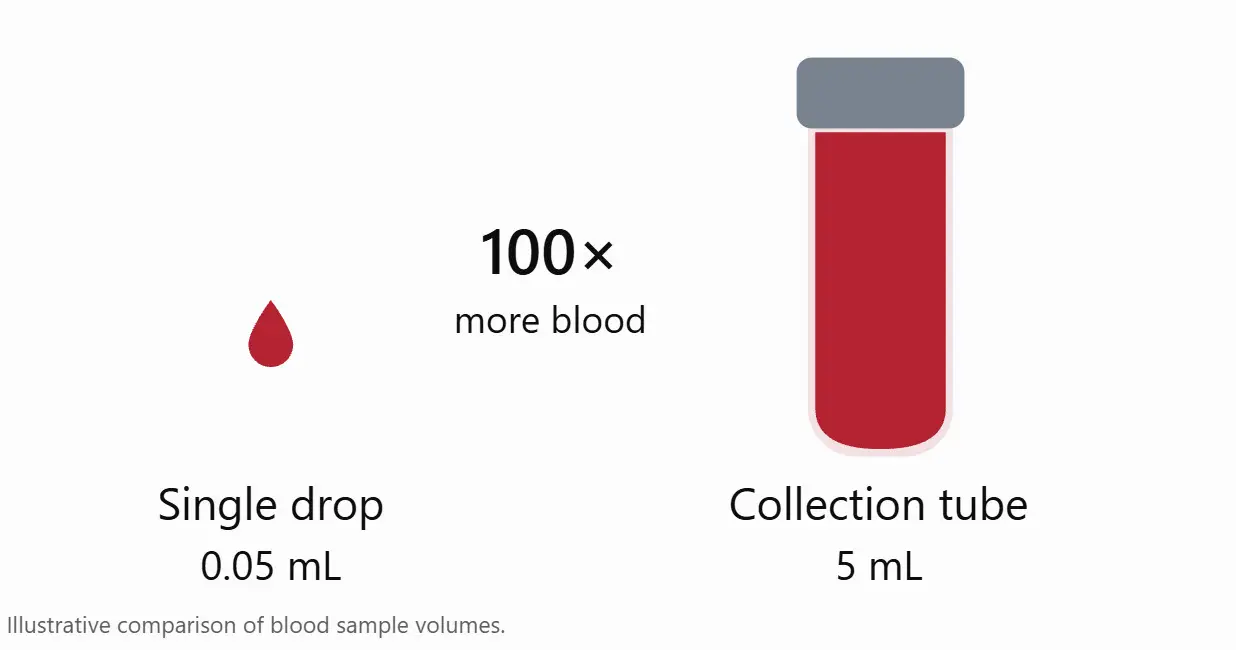
If you took a single drop of blood and divided it equally among 200 individual tests, each test would receive just 0.25 microliters. That assumes no loss of blood during collection, transportation, separation or processing. It also assumes each test requires the same amount of blood, which isn’t the case.
Some tests consume or chemically alter the sample, meaning the blood cannot simply be reused for the next test. Multiplex testing, where several measurements are performed on the same sample, can help overcome this problem, but not all diagnostic tests are compatible with one another.
However, the available volume of blood is only part of the problem. Something considerably more interesting happens when you examine the blood itself.
Not All Drops of Blood Are the Same
Imagine taking a teaspoon of water from a swimming pool to determine its chemical composition. Assuming the water is reasonably well circulated, the teaspoon should provide a fairly accurate representation of the entire pool.
Blood is different. It contains a combination of dissolved substances and suspended physical objects, including red blood cells, white blood cells, platelets, proteins, hormones and antibodies.
In 2015, researchers at Rice University conducted a study examining consecutive drops of blood collected from the same finger prick. What they discovered was that measurements of hemoglobin, white blood cells and platelets could vary significantly from one drop to the next.
In some of the individuals tested, hemoglobin measurements differed by more than two grams per deciliter between consecutive drops. For the measurements studied, averaging results from six to nine drops produced more consistent results comparable to conventional venous blood testing.
The important detail here is that the researchers were using established, hospital-grade testing equipment for much of their analysis. The variability wasn’t simply a consequence of inaccurate sensors. It was present in the samples themselves.
You can read the Rice University study here.
There is another complication. When a person squeezes their finger to produce more blood, tissue fluid can mix with the sample and affect its composition. The collection process can also rupture red blood cells, a condition known as hemolysis.
Red blood cells contain potassium. If those cells rupture, the potassium released into the sample can produce an artificially high potassium reading, potentially indicating a medical condition the patient doesn’t actually have.
Even a perfectly accurate sensor cannot compensate for every problem introduced during sample collection.
Why Not Simply Dilute the Blood?
One approach used by Theranos was diluting small blood samples so they could be processed by conventional laboratory equipment.
On the surface, this sounds reasonable. If you dilute something by a factor of ten, measure its concentration and multiply the result by ten, you should arrive at the original concentration.
But consider what happens when the substance you are looking for is already present in extremely small quantities. Diluting the blood can reduce its concentration below the detection threshold of the equipment.
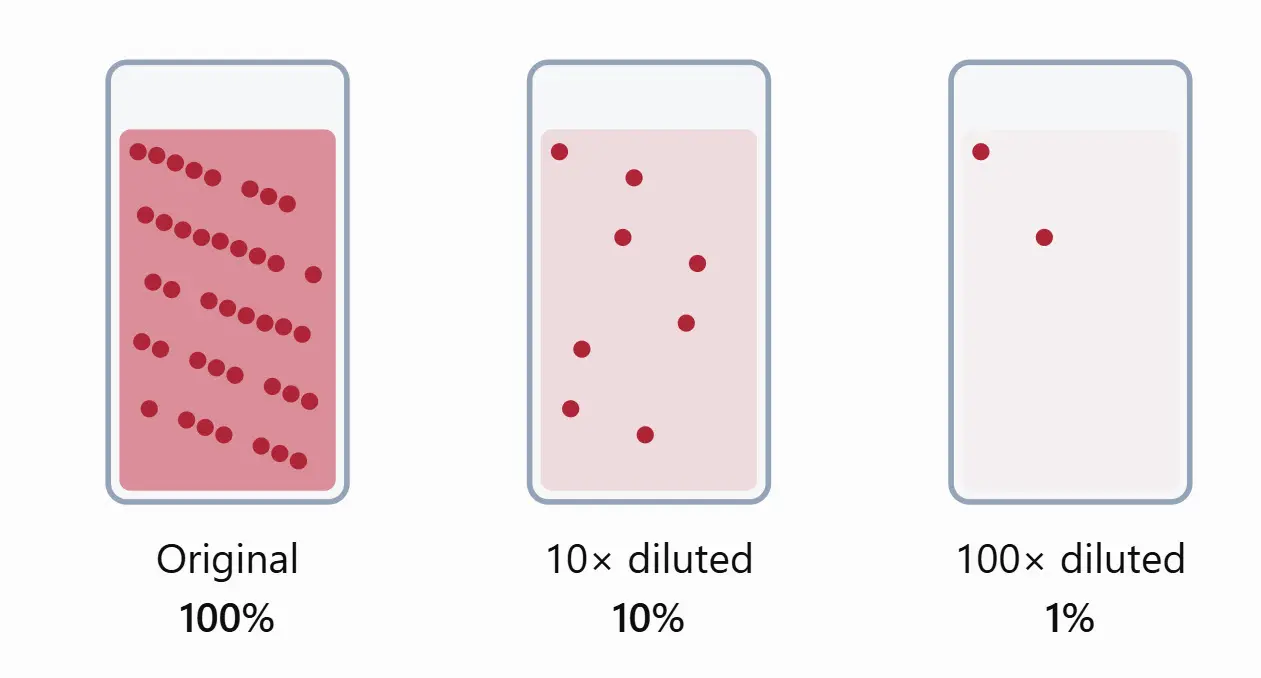
Adding liquid increases the volume of the sample, but it doesn’t increase the amount of the substance you are trying to detect.
There is also the problem of different testing methodologies. Measuring glucose, counting white blood cells, detecting antibodies and measuring testosterone are fundamentally different processes. Some require whole blood, others require plasma or serum, and some require chemical reactions that would interfere with other tests.
What Elizabeth Holmes was attempting to accomplish wasn’t simply the miniaturization of a blood testing instrument. She was attempting to miniaturize an entire laboratory.
None of this means small-volume blood testing is impossible. People with diabetes have been successfully testing glucose from tiny blood samples for years, and advancements in microfluidics and sensor technology continue to expand what can be accomplished.
The challenge is performing hundreds of different tests with sufficient accuracy and consistency to make reliable medical decisions.
From a Drop of Blood to a Cell of NAND
Now consider what the NAND flash memory industry has accomplished with a single memory cell.
Originally, a NAND memory cell stored one bit of information. Today, commercial NAND routinely stores three or four bits per cell, with five-bit technology under development.
What’s interesting is that every additional bit doubles the number of electrical states the memory must distinguish.
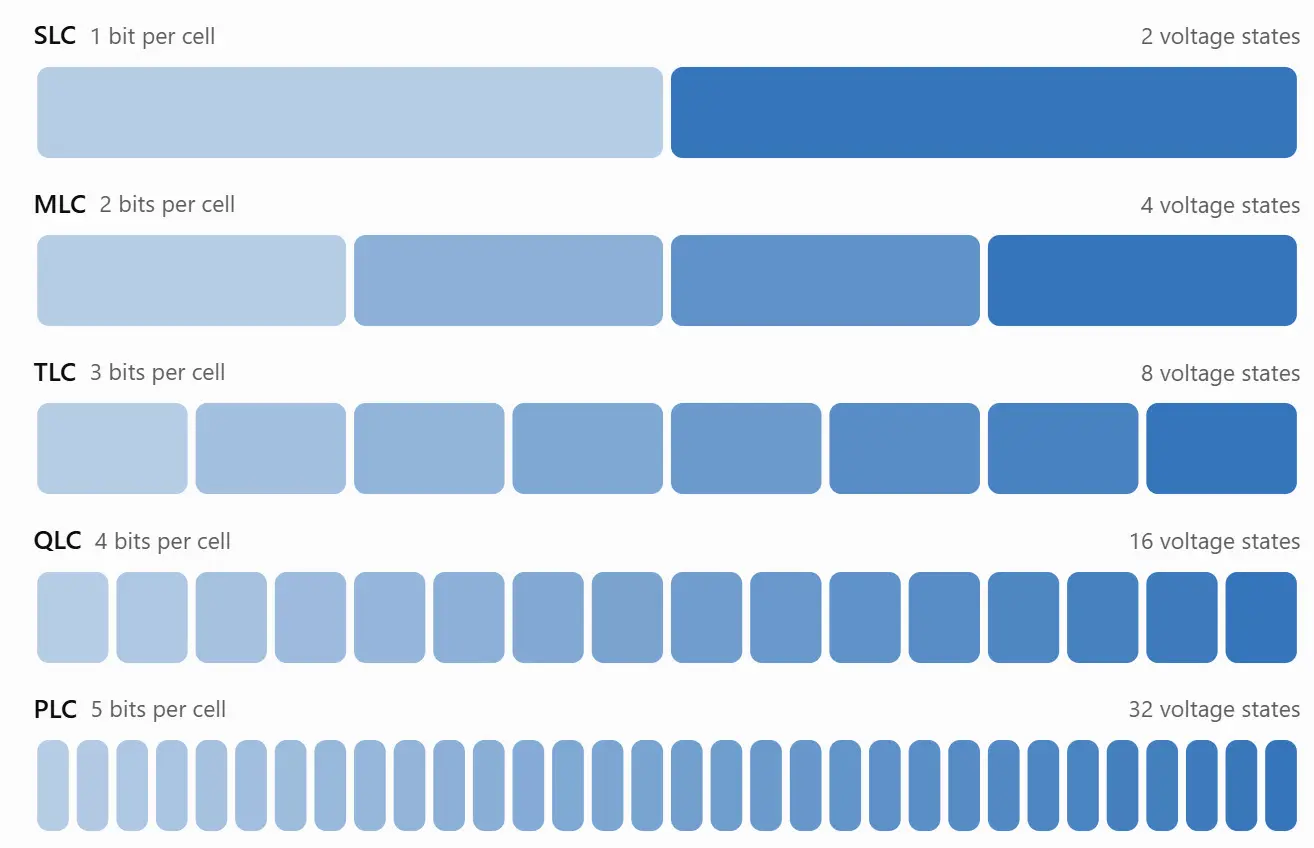
Going from SLC to QLC provides four times the storage capacity per cell, but increases the number of voltage states from two to sixteen. With PLC, that number increases to thirty-two.
The controller must distinguish between those states despite charge leakage, temperature fluctuations, manufacturing variations and the physical deterioration of the memory cell through repeated program and erase cycles.
Sound familiar?
Theranos was attempting to measure biological substances using increasingly limited sample volumes without sacrificing accuracy. NAND manufacturers are attempting to distinguish increasingly small differences in threshold voltage without sacrificing data integrity.
Why NAND Succeeded Where Theranos Failed
One significant advantage the NAND industry has over the medical testing industry is the ability to introduce redundancy into the information being measured.
When a flash memory controller writes data to NAND, it also generates error-correcting information. When the data is read back, the controller can use that additional information to detect and correct errors within certain limits. This is known as ECC, or Error Correction Code.
Think about that in the context of Theranos. Imagine if Elizabeth Holmes could introduce error-correcting information into a person’s bloodstream before collecting a sample. If some information was lost or misinterpreted during testing, her equipment could use that additional information to reconstruct the correct result.
Of course, that isn’t possible. NAND engineers have control over the original information being stored. Medical researchers do not have equivalent control over the biological material they are sampling.
NAND manufacturers have also developed other methods to compensate for the limitations of their technology. Read-retry algorithms adjust voltage thresholds when information becomes difficult to interpret. Wear leveling distributes the physical deterioration of memory across a larger number of cells. Spare memory provides replacement capacity when portions of the NAND become unreliable.
All of this happens behind the scenes when you plug a USB flash drive into your computer or save a photograph to a microSD card.
When Going Smaller Is No Longer the Best Answer
Another interesting development in the NAND industry was the recognition that continually shrinking planar memory cells wasn’t necessarily the best path toward greater storage capacity.
Rather than making everything smaller, manufacturers began building vertically. This is the technology we know today as 3D NAND.
Samsung has publicly discussed developing NAND with more than 1,000 vertical memory layers by 2030, a subject we recently covered in our article, Does Samsung Really Have a 1,000-Layer NAND Plan? Eight Questions Worth Asking.
Building vertically allows manufacturers to increase storage density without necessarily increasing the number of bits stored in each cell. Granted, manufacturing hundreds of microscopic layers introduces an entirely new set of engineering challenges, but it gives the industry another avenue for increasing capacity.
Perhaps there is a lesson here for the original Theranos concept. If collecting just one drop of blood creates a fundamental problem with obtaining reliable information, why insist on one drop? Would collecting six or ten drops make the technology any less revolutionary?
Compared to having several tubes of blood drawn from your arm, probably not.
The Difference Between Innovation and Ambition
There is nothing inherently wrong with what Elizabeth Holmes wanted to accomplish. The semiconductor industry is full of technological accomplishments that would have seemed unreasonable twenty or thirty years ago.
What separates successful engineering from an ambitious idea is the ability to demonstrate repeatable results under real-world conditions.
A NAND manufacturer cannot simply demonstrate that a memory cell can store five bits of information and declare the technology a success. The manufacturer must demonstrate that those five bits can be reliably retrieved after repeated write cycles, prolonged storage and exposure to different environmental conditions. The technology must also be economically viable to manufacture in volume.
Theranos never adequately demonstrated that its technology could deliver the broad range of reliable diagnostic results it promised, yet it proceeded to commercialize the technology.
The lesson from Theranos isn’t that miniaturization is impossible. The NAND flash memory industry has demonstrated just how far miniaturization can go.
The lesson is that making something smaller doesn’t eliminate the laws of physics. It simply makes them harder to work around.
And there is a significant difference between promising you’ve solved those problems and actually solving them.
Editorial Note: GetUSB.info has covered USB technology, NAND flash memory and digital storage since 2006. Our articles draw on industry experience, technical research and established engineering principles to provide readers with accurate, practical and independent perspectives on technology.
Let GetUSB.info keep you updated.
Receive article notifications about USB storage, flash memory, and duplication updates in your preferred language. We average a couple of articles per week.