
Comparing two USB packaging approaches means looking past appearance alone and focusing on what actually arrives in the customer’s hands.
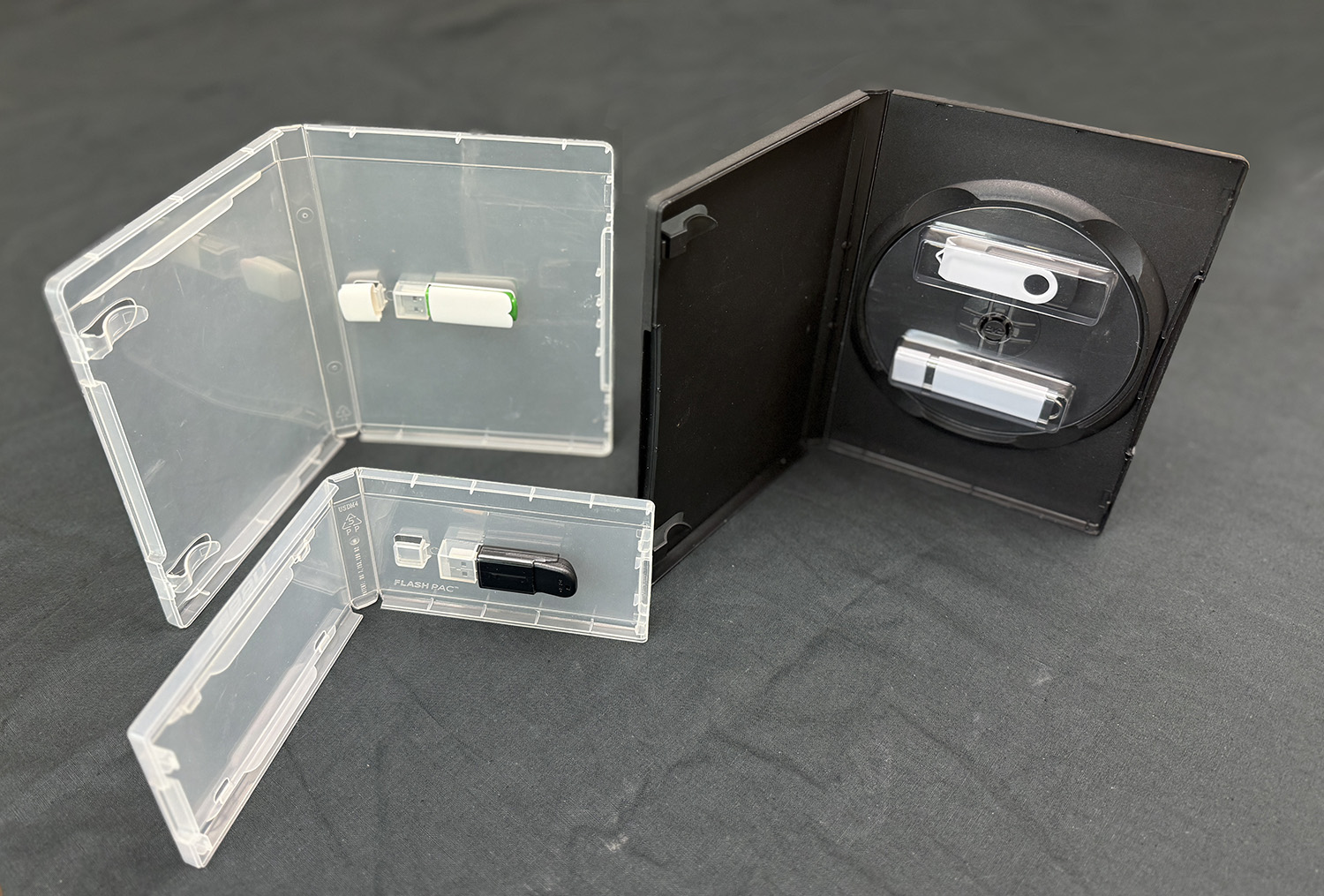
When distributing USB flash drives, packaging is not only about presentation. It also affects shipping reliability, user experience, and total cost. Two common options are the Flash Pac USB case and the USB to DVD insert. While both are designed to present USB media in a professional way, they solve the packaging problem in very different ways.
At a Glance: Comparison Table
| Feature | Flash Pac® | USB to DVD Insert |
|---|---|---|
| Primary Goal | Retail Aesthetic | Secure Distribution |
| Retention Method | Molded Retention Hub | Case Pressure + Slots |
| Connector Support | USB-A Only | Universal (USB-A & USB-C) |
| Approx. Cost | $1.50/unit | $0.75/unit (insert only) |
Visual Design and Presentation
The Flash Pac is designed as a standalone retail-style package. Its clear plastic enclosure and printable insert area make it a strong fit for marketing-driven applications where shelf appearance and presentation matter.
The USB to DVD insert takes a more practical approach. Instead of acting as a standalone package, it converts a standard DVD case into USB packaging. The result is familiar, simple, and easy to integrate into an existing distribution process.
Takeaway: Flash Pac leans more toward retail presentation, while the USB to DVD insert leans more toward practical distribution.
Functionality and Everyday Use
The Flash Pac holds a single USB drive and its cap using a molded plastic retention hub. It also allows room for printed inserts and small booklets, which can be useful when the package is intended to carry extra collateral. However, because the hub is molded specifically for the standard USB-A connector, it lacks the versatility to hold newer USB-C drives securely.
The USB to DVD insert snaps into the center hub of a standard DVD case and uses precision-cut slots to hold one or two USB drives. No adhesives or custom packaging materials are required. A major advantage here is universal compatibility; because the slots are designed to grip the body of the drive rather than the connector itself, the insert works perfectly for both standard USB-A and modern USB-C drives.
Takeaway: Flash Pac is a fixed package limited to USB-A hardware, while the USB to DVD insert is a universal solution that accommodates the industry shift toward USB-C.
Shipping Performance and Real-World Handling
This is where the difference between the two products becomes more noticeable.
With the Flash Pac, the retention system depends on a small molded retention hub or post that holds the USB connector and cap in place. In controlled handling this can work well enough, but during shipping, vibration and repeated movement can cause either the cap or the USB drive itself to come loose from that holding point.
One of the more common real-world complaints is that the end user receives the package and can hear the flash drive moving around inside the case. Even when the package still looks fine from the outside, that loose movement reduces confidence in the packaging and creates the impression that something failed during transit.
The USB to DVD insert solves the problem in a different way. The flash drive is held in molded slots, and once the DVD case is closed, the pressure from the closed case helps lock the USB drive into position. In other words, the case itself becomes part of the retention system. That added pressure keeps the drive from shifting around during shipping and gives the packaging a more secure feel when it arrives.
Takeaway: Flash Pac relies on a single molded point that can loosen in transit, while the USB to DVD insert benefits from the closed DVD case applying pressure to keep the drive firmly in place.
Cost and Scalability
The Flash Pac starts at about $1.50 per unit. The USB to DVD insert starts at about $0.75 per unit, although that price does not include the DVD case itself.
That said, many organizations already have DVD cases in stock, and standard cases are still easy to source at low cost. Because of that, the USB to DVD insert can become a more economical solution, especially for larger runs or for companies trying to reuse existing packaging supplies.
Takeaway: Flash Pac is the higher-cost all-in-one option, while the USB to DVD insert is the lower-cost modular approach that can scale more efficiently.
Best Fit by Use Case
The Flash Pac is better suited for retail-style presentation, branded marketing kits, and situations where printed inserts and a compact standalone package are the main priorities—provided you are only distributing standard USB-A drives.
The USB to DVD insert is better suited for training kits, software distribution, onboarding materials, corporate handouts, and bulk shipments where cost control, secure delivery, and the flexibility to use any type of USB hardware (A or C) matter most.
Review of Product Video
Final Thoughts
Both products serve the same basic purpose, but they prioritize different outcomes.
The Flash Pac is centered more on presentation and standalone packaging convenience. It can be a good fit when appearance and printed collateral are the main focus and the hardware is legacy USB-A.
The USB to DVD insert is centered more on stability, cost-efficiency, and compatibility with an existing DVD-case workflow. Because the closed DVD case adds pressure that helps secure the drive, it offers a practical advantage for shipping and handling.
Bottom line: If the priority is a retail-style presentation package specifically for USB-A drives, the Flash Pac remains a valid option. However, for a more secure, lower-cost, and truly universal solution that handles both USB-A and USB-C, the USB to DVD insert is the superior pick for real-world distribution.
Product Links In This Review
Flash Pac® product page for more details
USB-to-DVD-Insert product page for more details
Review Note
This comparison was written from direct product observation and packaging-use evaluation. The image used with this review was photographed in-house to show the actual packaging format being discussed, rather than relying on a stock image that may not reflect real-world handling or fit.
No commission or compensation is earned from the links included in this post. They are provided strictly for reference and product context.
Final wording and structure were lightly refined with editorial assistance for readability, but the comparison points, product observations, and conclusions were determined by the author.
Let GetUSB.info keep you updated.
Receive article notifications about USB storage, flash memory, and duplication updates in your preferred language. We average a couple of articles per week.

