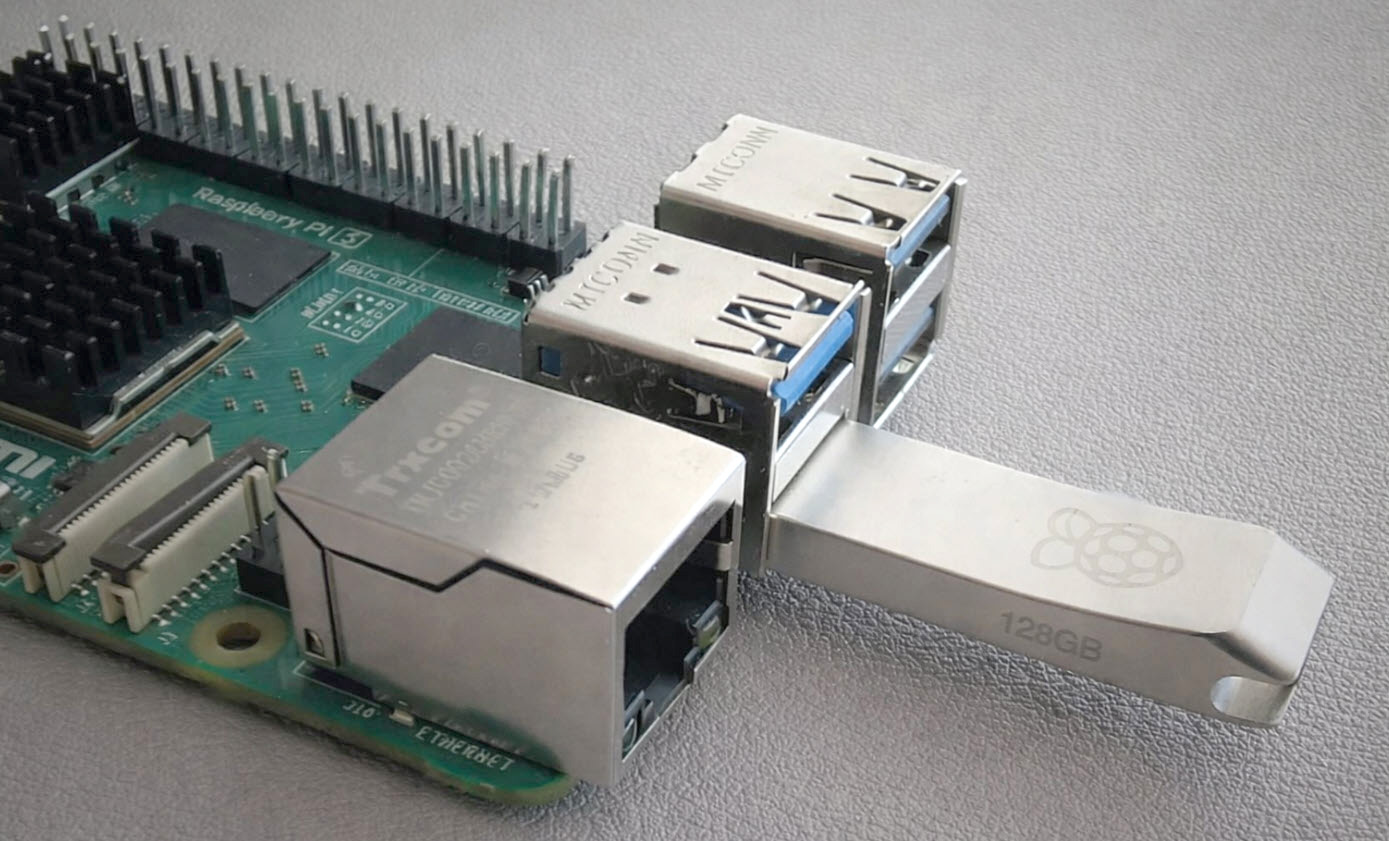
Raspberry Pi’s new USB flash drive appears to be a solid implementation of familiar controller technology, not a new storage invention.
The Raspberry Pi team recently introduced a branded USB flash drive aimed at developers and hobbyists who want dependable removable storage for their boards and systems. On paper, the device looks well put together: an aluminum enclosure, respectable sustained speeds, and firmware features usually associated with better-quality flash products.
One part of the announcement stands out right away: the description of pseudo-SLC cache behavior used to accelerate writes on QLC NAND. Read quickly, that language can sound proprietary or unusual. It is not. It is a standard technique used across modern flash storage.
That distinction is worth keeping straight because it helps separate a genuinely better product from a claim that makes a normal controller feature sound exotic.
The pSLC Cache Explanation
Raspberry Pi explains that the drive temporarily writes data into a pseudo-SLC cache, then later moves that data into slower QLC storage in the background. That process is presented as a way to improve performance during burst-type workloads.
Technically, that explanation is correct. It is also very common.
Most modern flash storage devices built around TLC or QLC NAND rely on the same strategy. The controller temporarily operates part of the NAND in single-bit mode to improve write performance, then consolidates the data later when the system is idle.
You see this architecture in USB flash drives, SSDs, SD cards, microSD cards, eMMC products, and other embedded flash devices. So this is not a new controller invention. It is normal firmware behavior in modern NAND controllers.
Why the Technique Exists
QLC NAND offers high density and lower cost, but it writes data more slowly than earlier flash types. Controller vendors addressed that years ago by using a dynamic SLC cache layer.
In plain terms, incoming data is written quickly into the pSLC cache, the controller delivers strong burst performance, and later the data is reorganized into QLC blocks during idle time. That keeps the device responsive during normal workloads, especially when users copy smaller files or shorter bursts of data.
It is a smart and proven design approach, but it is also standard practice throughout the flash industry.
The More Interesting Part Is the Sustained Write Claim
The Raspberry Pi announcement becomes more interesting in how performance is presented. Instead of quoting burst speeds measured while the cache is still active, Raspberry Pi says its published numbers are sustained write figures measured after the cache is forced into write-through mode.
That is a stronger and more honest way to talk about performance.
Many low-cost flash drives advertise only their short burst speed, which can look impressive for a brief moment and then collapse once the cache fills. By publishing sustained numbers instead, Raspberry Pi is signaling that the drive was measured under more realistic conditions. In a market full of optimistic speed claims, that is a meaningful difference.
Reliability Says More Than the Cache Talking Point
Another part of the Raspberry Pi announcement deserves more attention than the caching language. The company says it validated the drive through tens of thousands of random power cycles while running intermittently intensive I/O workloads.
That gets closer to what separates better flash media from bargain-bin products. Cheap USB drives often fail at the exact moment users care most about: surprise removal, sudden disconnection, or unstable power. A controller can look fine on a spec sheet and still behave poorly in the field if the firmware validation is weak.
So the stronger message from Raspberry Pi is not the pSLC cache feature. The stronger message is that the product appears to have been tested and qualified more carefully than the average low-cost thumb drive.
What This Really Means
The broader takeaway is fairly simple. Raspberry Pi appears to be using a well-specified flash design built around standard modern controller techniques, not introducing a fundamentally new storage architecture.
The difference likely comes down to better controller selection, firmware tuning, NAND qualification, reliability testing, and more disciplined performance reporting. Those decisions can absolutely improve real-world usability. They just should not be mistaken for a proprietary caching breakthrough.
The Controller Is Where the Real Quality Shows Up
In the removable media market, much of the real value sits inside the controller and the firmware wrapped around it. The controller manages wear leveling, error correction, garbage collection, caching behavior, bad block handling, and recovery from unexpected interruptions. A cheap controller can make decent NAND look mediocre. A better controller, paired with stronger firmware and validation, can make the same class of NAND far more dependable.
That is exactly where Nexcopy Controlled USB Flash Media enters the picture. Nexcopy has built a platform of controller-driven USB products designed around consistency, reliability, and application-specific behavior rather than low-end commodity pricing. That product family includes Disc License, Lock License, Copy Secure, and Fixed Disk solutions, each built for use cases where the controller behavior and firmware feature set are part of the product value, not just background components hidden behind the plastic shell.
That point often gets lost in consumer flash discussions. Buyers tend to focus on capacity and advertised transfer speed, while the better question is whether the controller platform underneath has been selected and tuned for the job it is expected to do.
The Bottom Line
Raspberry Pi’s new flash drive looks like a thoughtfully built accessory, and there is no need to take shots at it to say so. It appears to use the same class of modern controller behavior that better flash products have relied on for years. The pSLC cache feature highlighted in the announcement is not unique. It is part of the normal playbook for modern flash design.
What likely makes the Raspberry Pi drive better than many cheap alternatives is not some secret controller invention. It is the more practical combination of decent component selection, stronger validation, and a willingness to publish sustained numbers instead of marketing-only burst speeds.
That is a fair position for Raspberry Pi to take. At the same time, the market should recognize that controller-based flash quality is hardly new territory. Companies like Nexcopy have been building product platforms around controlled flash behavior for years, proving that the real advantage is not in dressing up a common controller function as something rare, but in knowing how to apply that controller technology to deliver a more dependable result.