Electric vehicle batteries and NAND flash couldn’t appear more different. One stores electricity, the other stores digital information. One powers automobiles while the other powers smartphones, laptops, USB flash drives, and solid-state storage. Yet behind the factory walls, both industries follow remarkably similar economic rules.
Both require staggering capital investments before the first product ever reaches a customer. Both depend on relentless manufacturing improvements to remain competitive. Both experience years of falling production costs as factories become more efficient. And eventually, both find themselves competing in markets where buyers increasingly compare price just as much as performance.
It may seem like an unusual comparison, but the similarities become obvious once you look at the numbers.
The Race to Lower Costs
The first chart compares the long-term decline in manufacturing costs for electric vehicle battery packs and NAND flash memory. Although the products measure different things—battery capacity is priced by the kilowatt-hourA unit of energy equal to one kilowatt of power used for one hour. while flash memory is often measured by the gigabyte—the trend is remarkably similar when both are indexed to the same starting point.
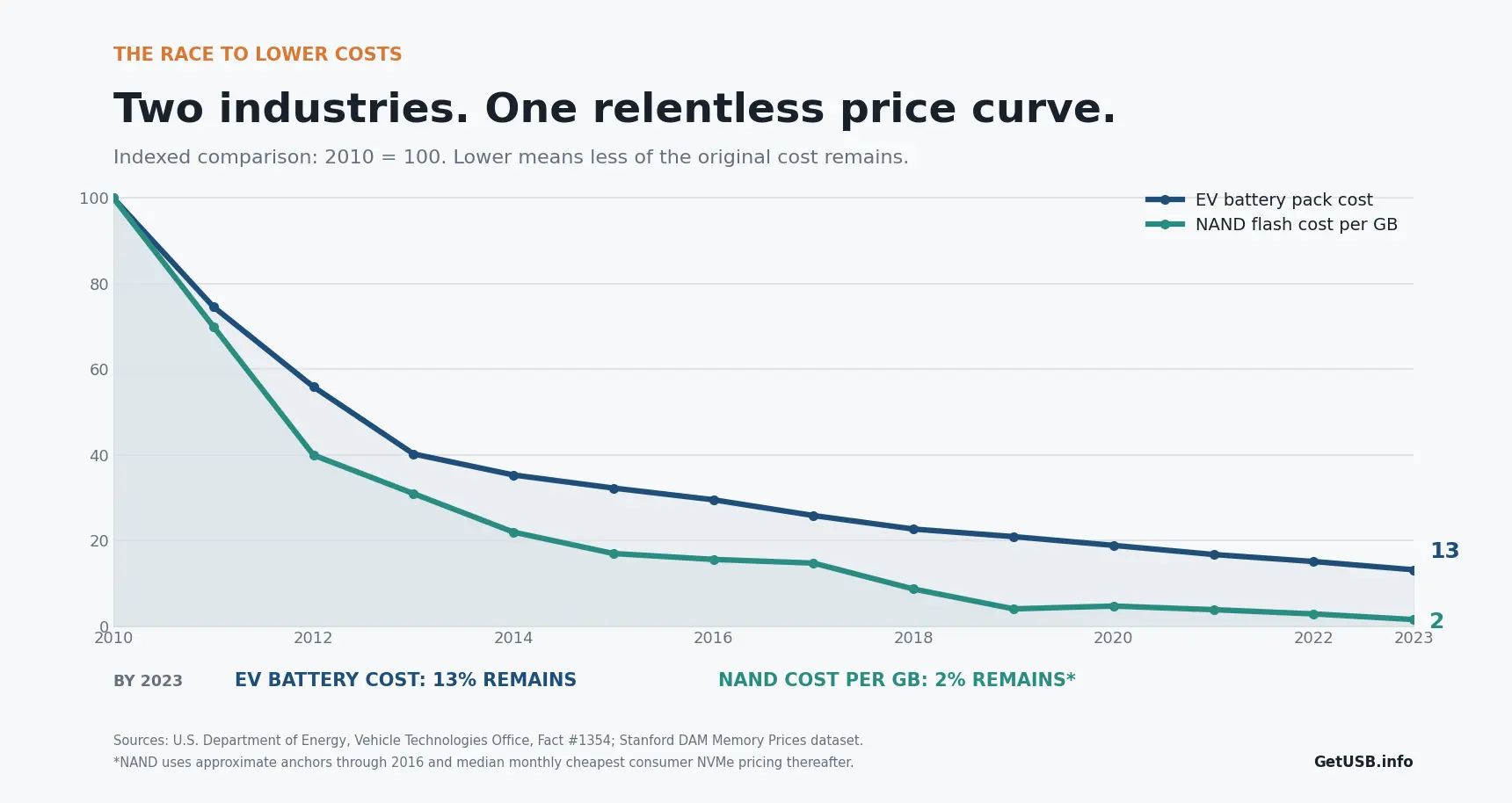
Neither industry reduced prices because the technology became simpler. Quite the opposite.
Neither industry reduced prices because the technology became simpler. Quite the opposite. Battery chemistry continued to improve while NAND manufacturers advanced from planar flash into increasingly complex 3D NAND architectures containing hundreds of memory layers. Manufacturing became more sophisticated, not less. Manufacturing became more sophisticated, not less.
What changed was the manufacturing process. Higher production volumes, better automation, improved yields, faster equipment, larger factories, and years of engineering refinements steadily reduced the cost of producing each individual unit. The result is a classic manufacturing learning curve: the more efficiently companies build a product, the less each unit costs to produce.
This pattern has repeated itself throughout modern manufacturing history. Once production scales and competitors adopt similar techniques, prices trend downward even while the underlying technology becomes more advanced.
The Billion-Dollar Barrier
Lower product prices do not mean manufacturing has become inexpensive. In fact, the opposite is often true.
Today’s battery gigafactoriesLarge-scale manufacturing facilities designed to produce electric vehicle batteries and other advanced technologies at massive volumes.and semiconductor fabrication facilities represent some of the largest industrial investments on the planet. Building one requires years of planning, specialized equipment, advanced automation, highly trained engineers, and billions of dollars before meaningful production begins. Every new generation of manufacturing equipment raises the cost of entering the market.
The second chart illustrates that reality. Major battery manufacturers and semiconductor companies routinely announce projects costing several billion dollars, with advanced memory fabrication facilities often exceeding ten billion dollars in investment. These are not ordinary factories—they are among the most technologically sophisticated manufacturing environments ever constructed.
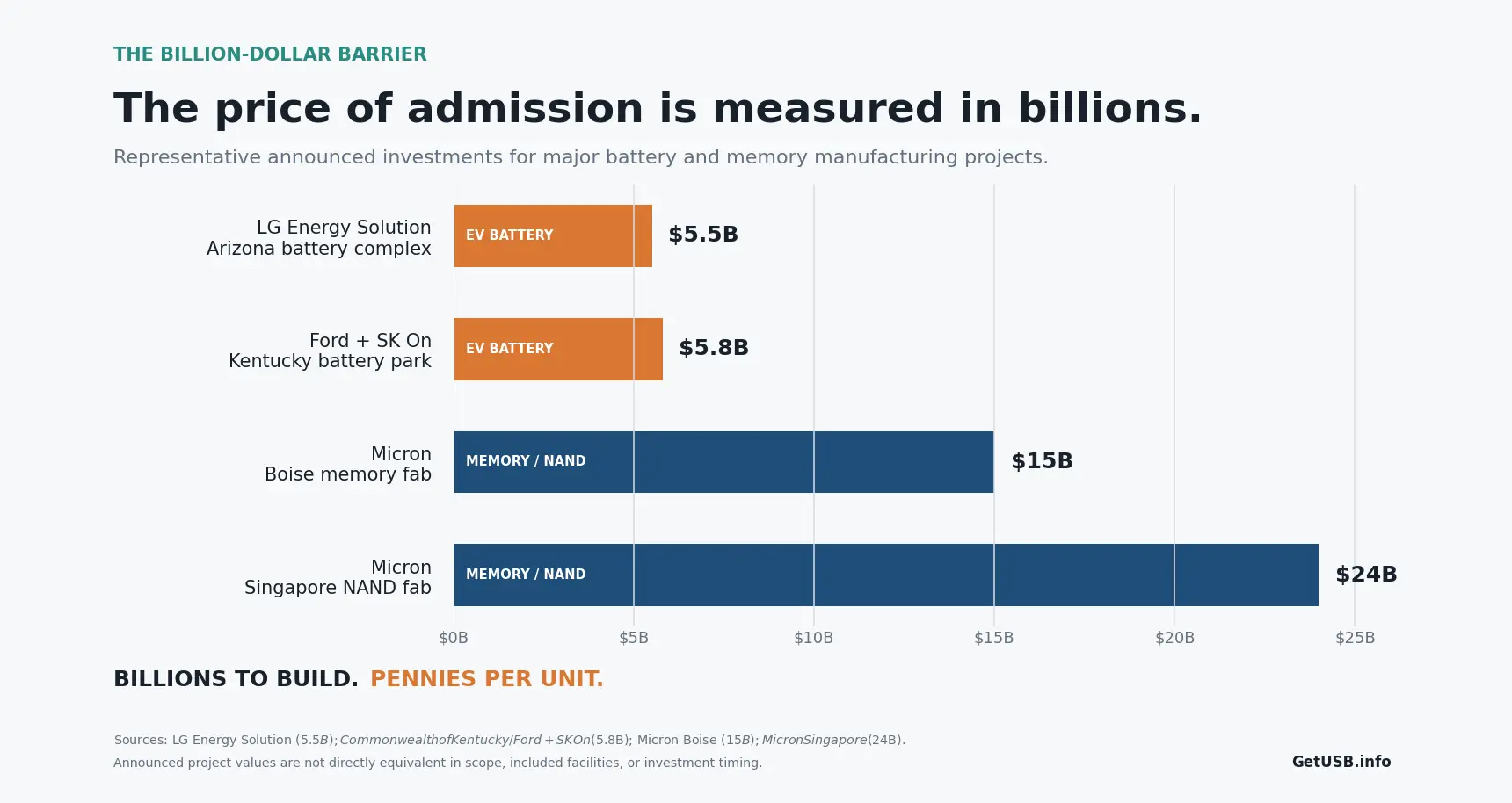
The irony is difficult to ignore. Every new factory increases production capacity, improves manufacturing efficiency, and ultimately places additional downward pressure on product pricing. The very investments that make better products possible also accelerate the competition that reduces profit margins.
When Innovation Becomes a Commodity
Consumers benefit enormously from this cycle. Flash memory is now inexpensive enough to store terabytes of data in the palm of your hand, while electric vehicles continue to become more affordable as battery costs decline. Those lower prices are the direct result of decades of engineering investment and manufacturing innovation.
For manufacturers, however, success becomes increasingly difficult. Building the world’s most advanced production facility is only the beginning. Once multiple companies achieve similar manufacturing capabilities, purchasing decisions increasingly shift toward price, availability, reliability, and supply. The technology remains extraordinary even as the finished product becomes increasingly interchangeable.
At first glance, NAND flash and electric vehicle batteries appear to belong to completely different industries. One stores data while the other stores energy. Yet their manufacturing economics tell nearly the same story: invest billions to build world-class factories, continuously improve production efficiency, and compete in markets where every penny matters.
Building the future may cost billions. Selling it often comes down to pennies.
Let GetUSB.info keep you updated.
Receive article notifications about USB storage, flash memory, and duplication updates in your preferred language. We average a couple of articles per week.