Are There Tariffs on USB Flash Drives in 2026?
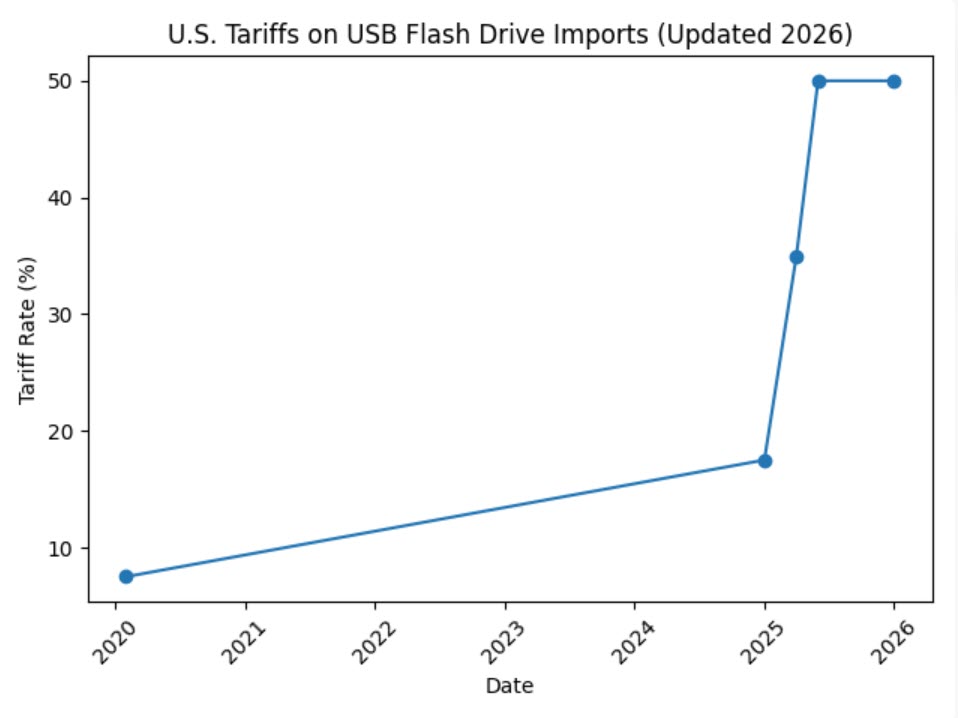
Yes. As of 2026, USB flash drives imported into the United States – particularly those manufactured in China – continue to be subject to layered tariffs. These are not single, simple percentages, but rather a stack of trade policies built over several years and adjusted through ongoing geopolitical negotiations.
The result is straightforward: USB flash drives cost more to import today than they did just a few years ago.
Where Things Stand in 2026
Since 2020, USB flash drives have fallen under multiple tariff actions tied to broader trade tensions between the United States and China. These include:
- Original Section 301 tariffs introduced during the first Trump administration
- Additional tariff layers introduced in 2025 during renewed trade actions
- Escalations and retaliatory measures between the U.S. and China
Depending on classification, timing, and interpretation by customs, the effective tariff burden can range widely. In many real-world import scenarios, total landed cost increases can exceed 50% or more when combining tariffs, duties, logistics, and compliance overhead.
The important point is not the exact percentage – because that number changes – but the trend: USB flash media is no longer a low-friction import product.
Why This Matters More Than People Think
Most coverage of USB drives focuses on speed, capacity, or price per gigabyte. What rarely gets discussed is how dependent the entire category is on global manufacturing.
There are no major USB flash drive manufacturers producing at scale within the United States. Companies like Kingston, Western Digital, Micron, and Nexcopy all rely on overseas production – primarily in China or nearby regions.
Even if final assembly moved to another country, the core component – NAND flash memory – is still sourced through a highly concentrated global supply chain. That means tariffs applied at any point in the chain ripple through the entire product cost.
In simple terms: you cannot “route around” this problem.
Does This Help U.S. Manufacturing?
In theory, tariffs are designed to encourage domestic production. The idea is that higher import costs make local manufacturing more attractive.
In reality, that doesn’t translate well to USB flash drives.
The infrastructure required to manufacture NAND flash and USB controllers at scale does not exist in the United States for this category. Even if assembly were relocated domestically, the most expensive part of the product – the memory itself – would still be imported.
Since NAND accounts for the majority of a USB drive’s cost, tariffs effectively act as a price increase rather than a catalyst for reshoring production.
What This Means for Pricing
For businesses and consumers, tariffs show up in subtle ways:
- Higher unit pricing from suppliers
- Reduced margin for distributors and resellers
- Less flexibility for customization or short-run production
- Increased volatility in pricing over time
This is why USB pricing today can feel inconsistent – it’s not just memory pricing cycles anymore, it’s also trade policy layered on top.
Can Tariffs Be Avoided?
Short answer: not really.
Some common ideas don’t hold up in practice:
- Routing shipments through another country ? adds cost and complexity
- Breaking shipments into smaller values ? not scalable and easily flagged
- Switching suppliers ? most still rely on the same upstream components
There is still a de minimis threshold (typically under $800), but this is irrelevant for commercial buyers or manufacturers moving volume.
For reference, USB flash drives fall under
harmonized code 8523.51.00.00, which is where these tariff rules are applied – something we first outlined back in 2025.
The Bigger Picture
Tariffs on USB flash drives are not really about USB drives.
They are part of a much larger negotiation around global trade, technology supply chains, and economic leverage between major countries.
From a practical standpoint, though, the outcome is simple:
The cost of moving data on physical media is now tied not just to technology, but to politics.
And for an industry built on low-cost, high-volume manufacturing, that’s a meaningful shift.