Storing Data in Living Protein Isn’t Science Fiction Anymore
Scientists are experimenting with biological systems as a new medium for long-term data storage
Every few years, someone declares that we’re “running out of storage.” Scientists tend to respond the same way every time: Fine — we’ll just store data in glass… or DNA… or a living brain.
And no, they’re not joking.
Once you step outside the familiar world of silicon and NAND flash, data storage stops looking like chips and circuit boards and starts looking like something pulled from a biology lab, a physics experiment, or a science-fiction novel. What’s striking is that none of this is theoretical hand-waving. In one form or another, every idea you’re about to read has already been demonstrated in real labs—often working far better than intuition would suggest.
Let’s start with one of the least intuitive ideas that, once you sit with it, actually makes a lot of sense: DNA.
DNA already stores information. That’s literally its job. Every cell in your body carries a complete instruction manual for building you, written in a four-letter code. Scientists eventually realized that if biology can store that much information so densely and reliably, maybe we can piggyback on the same system.
By translating binary data into combinations of A, C, G, and T, researchers have already stored books, images, movies, and even entire operating systems inside synthetic DNA strands. The density is absurd. A single gram of DNA could theoretically hold hundreds of petabytes of data. Stored correctly, it could last thousands of years.
The catch, of course, is speed. Writing and reading DNA is slow and expensive, so this isn’t replacing your SSD anytime soon. But as a long-term archive, DNA starts to look less like a novelty and more like a biological vault.
Once you accept that molecules themselves can store data, proteins are the next logical step—and this is where things start getting strange.
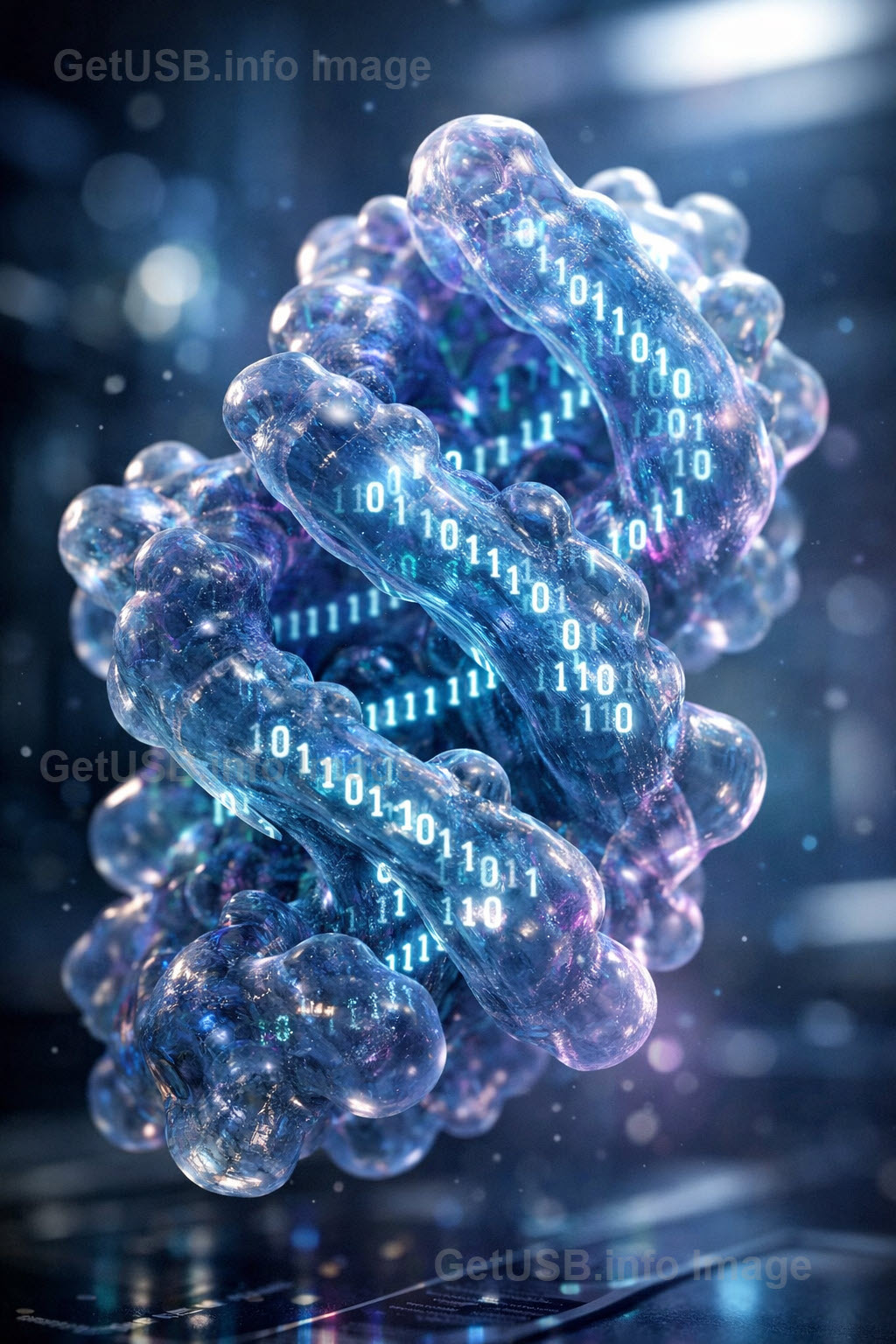
Proteins don’t just sit there; they fold. The exact way a protein folds determines how it behaves, and in some cases, that folding can change in stable, repeatable ways. Scientists have engineered proteins that flip between multiple shapes, with each shape representing a different data state. In effect, a single molecule becomes a microscopic switch.
Cells already use this trick to “remember” past signals, so researchers are essentially hijacking biology’s own memory system. This idea isn’t even new. Nearly two decades ago, experiments were already showing how biological proteins could be used to store staggering amounts of data, long before “bio-storage” became a buzzword.
It works, but it’s fragile. Temperature, chemistry, and time all interfere. Still, the notion that information can be stored in the way a molecule curls up on itself is one of those ideas that tends to stick in your brain.