
CompactFlash: The OG of Portable Storage
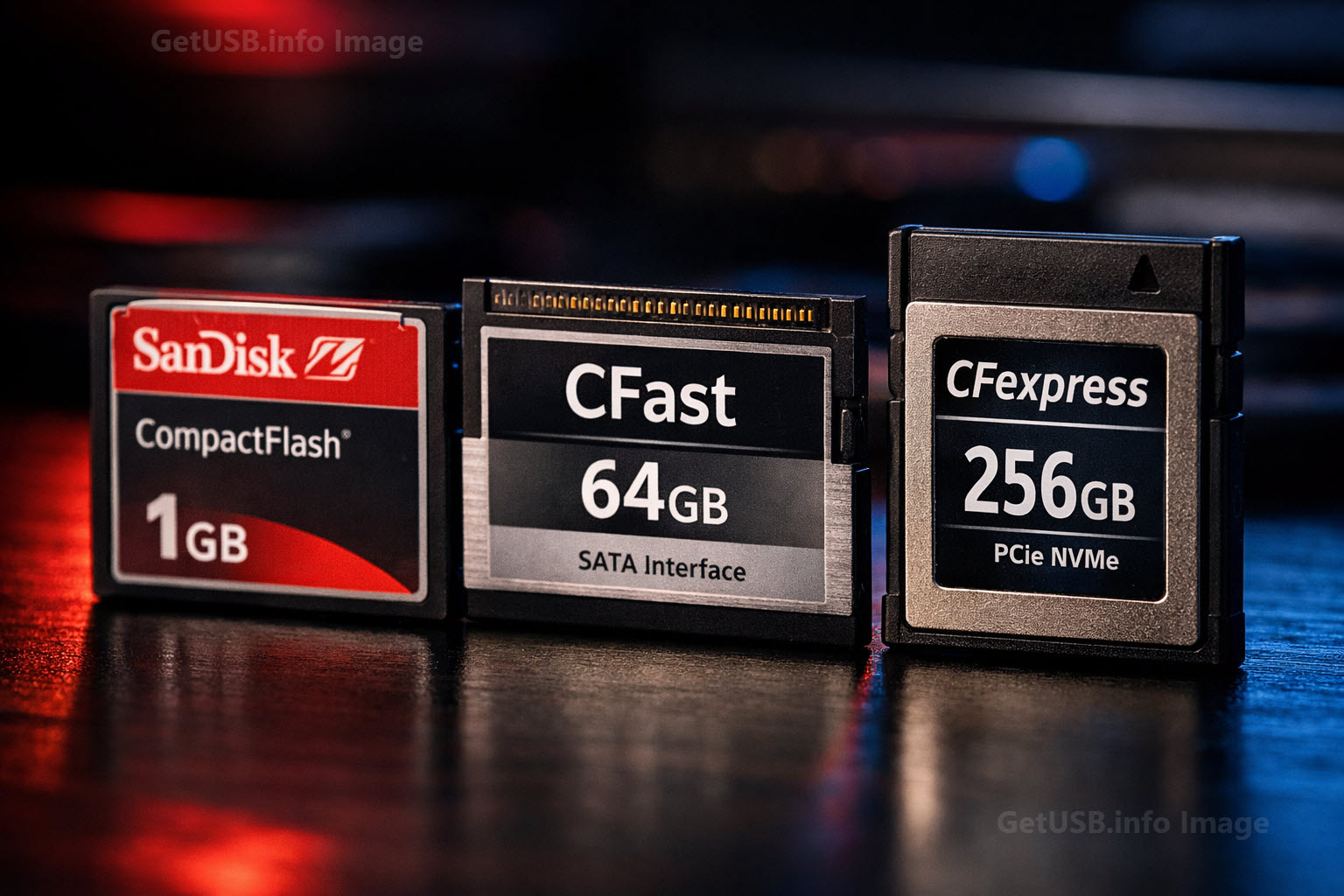
CompactFlash is The “Original Gangster” of Portable Storage That Quietly Built the Foundation for Today’s Removable Media
Pull up a stool, grab whatever’s in the glass, and let’s talk about a piece of technology that doesn’t get nearly enough respect. Everyone thinks the USB flash drive is the hero of portable storage. That tiny plastic stick that lives on your keychain. The one you’ve lost twelve times. But the real origin story? That goes further back. Before USB was cool. Before laptops were thin. Before cameras shot video. The real OG of modern portable storage was CompactFlash.
CompactFlash showed up in 1994, which doesn’t sound that old until you remember what the tech world looked like in 1994. Dial-up modems. Beige towers. Laptops that felt like gym equipment. Storage was floppy disks, Zip drives, and spinning rust hard drives. Flash memory existed, but it was exotic. Expensive. Mostly for embedded systems and industrial gear. Then SanDisk rolled out CompactFlash and quietly changed the entire trajectory of removable storage.
The thing people miss is this: CompactFlash wasn’t built for consumers. It wasn’t designed for casual file swapping. It was engineered for professionals and systems builders. Engineers could plug a CF card straight into an IDE bus and the system would just treat it like a hard drive. No tricks. No translation layers. It was, effectively, a ruggedized removable SSD before SSDs existed.
That’s why it spread so quickly through serious equipment. Digital cameras adopted it because nothing else could keep up. Industrial PCs standardized on it. Medical equipment manufacturers trusted it. Military systems certified it. It wasn’t trendy. It was reliable. And that reputation mattered.
By the time USB flash drives started to show up around 2000, CompactFlash was already an established ecosystem. While USB sticks were solving convenience — “here, copy this file” — CompactFlash was solving architecture — “here, boot this system, log this data, store this workload, and don’t fail.” Those are very different design goals.
The Prime Years of CompactFlash
CompactFlash launched in 1994, but like most technologies, it took a few years to hit its stride. The real growth curve didn’t start until the late 1990s when digital cameras exploded in popularity and embedded systems started standardizing around flash-based storage.
- 1994–1998: Early adoption in embedded devices, industrial systems, and early digital cameras
- 1999–2005: Rapid growth as DSLR cameras and professional equipment standardized on CF
- 2006–2012: Peak years, where CF dominated professional photography, broadcast, industrial, and embedded platforms
Roughly speaking, the prime years of CompactFlash were 2000 through 2012. During that window, high-end DSLR cameras almost universally used CF. Industrial PCs commonly booted from CF. Defense, aerospace, and medical platforms standardized on it for years. Capacities climbed from megabytes to hundreds of gigabytes. Transfer modes evolved all the way up to UDMA 7. It wasn’t just surviving — it was thriving.
You can actually see echoes of that era in early GetUSB.info coverage. Back in 2006, articles were already celebrating milestones like the world’s largest capacity flash drive hitting 16GB. That kind of headline mattered back then. Today, 16GB is what you find in a giveaway stick at a trade show. But at the time, it was a serious leap forward, and CompactFlash-class media was the foundation that made those scaling curves possible. :contentReference[oaicite:1]{index=1}
At the same time, USB flash drives were carving out a totally different niche. People were experimenting with running applications directly from a stick, like in the 2007 post about running Mobile Firefox from a flash drive. That was clever, useful, and forward-thinking — but notice the difference in intent. USB sticks were about portability and convenience. CompactFlash was about infrastructure. Two different philosophies, evolving in parallel. :contentReference[oaicite:2]{index=2}
Why CompactFlash Eventually Hit the Wall
Now, every good technology eventually runs into physics. CompactFlash didn’t fade away because people stopped needing it. It plateaued because its underlying architecture simply couldn’t scale forever. It was built on Parallel ATA signaling, inherited from an era when wider buses were the answer to higher performance. That approach works up to a point, and then the math turns against you.
Signal integrity issues start creeping in. Crosstalk becomes harder to control. Clock rates stop scaling cleanly. Power consumption climbs. And the connector itself becomes part of the bottleneck. CompactFlash’s 50-pin connector simply wasn’t designed with multi-gigabit serial signaling in mind. There was no practical path to PCIe-style lanes. No room to evolve the electrical design without breaking backward compatibility.
By around 2010 to 2012, even with better NAND and smarter controllers, CF was effectively boxed in by its own success. UDMA 7 topped out at 167 MB/s theoretical. Real-world cards were often slower. That was fine for still photography. It was marginal for early video. And it became completely inadequate once high-bitrate video, RAW burst shooting, and multi-channel data capture became normal.
This wasn’t marketing hype. Engineers were hitting real constraints. Buffers were filling. Cameras were stalling. Embedded systems were waiting on storage. When a storage medium becomes the bottleneck of an entire platform, that’s when the industry starts looking for the next step.
Why CFast Was Created (and Why CFexpress Followed)
This is where the lineage actually makes sense if you look at it sober — or at least buzzed enough to see the pattern. CFast didn’t exist to replace CompactFlash as a brand refresh. It existed to replace CompactFlash’s electrical architecture.
Instead of trying to stretch Parallel ATA further than physics would allow, CFast threw out the old bus entirely and rebuilt the card around SATA. Same general idea: removable, rugged, professional-grade media. But underneath, a modern serial storage interface that could scale from 150 MB/s to 300 MB/s to 600 MB/s. It was a logical evolution. Technically sound. Architecturally clean.
CFast solved the immediate problem. But it also inherited a new one. SATA itself began to hit its own ceiling. The rest of the computing world had already moved to PCIe and NVMe. SSDs weren’t using SATA anymore. High-performance storage had shifted to multi-lane PCIe architectures with massively higher bandwidth potential.
That’s where CFexpress comes in. CFexpress is not a random new format. It’s the continuation of the same design philosophy CompactFlash started with back in 1994: align removable media with the dominant system bus of the era. CompactFlash aligned with IDE. CFast aligned with SATA. CFexpress aligns with PCIe and NVMe.
- CompactFlash evolved because its Parallel ATA bus became obsolete
- CFast evolved because SATA began to look like a dead end
- CFexpress exists because modern computing is fundamentally built on PCIe and NVMe
This is also why there’s no obvious successor waiting in the wings for CFexpress right now. PCIe continues to scale. NVMe continues to evolve. The entire data center, consumer PC, and mobile computing ecosystem is built around this architecture. For once, removable media is aligned with the same technological foundation as everything else, instead of lagging a generation behind.
And when you zoom out far enough, that’s the real story. CompactFlash wasn’t just a card format. It was the first widely adopted, standardized, multi-vendor ecosystem for portable solid-state storage. It created the template. Everything that followed — SD, USB flash drives, CFast, CFexpress — is riffing on the same basic idea: small, rugged, removable, scalable storage that behaves like real storage, not like a toy.
So yeah, if you’re sitting at the bar and someone starts talking about how USB sticks changed everything, you can smile, take a sip, and say: “Sure… but CompactFlash did it first.” And you won’t just be nostalgic. You’ll be historically correct.
Tags: CFast, CFexpress, CompactFlash, flash storage history, removable storage
