Hovercam X500 is great name for the function it performs, hovering over documents to project via camera. The Hovercam is meant to replace the age old overhead projector we are most familiar with from grade school.
The X500 USB imaging device has a 5 megapixel sensor mounted on a swing arm that can either scan and recognize or monitor and project anything on the surface underneath. As a scanner, the HoverCam performs as a 600dpi equivalent scanner. Scans are snapped as photos would be, in an instant. No more waiting for the slow trudging of the scan sensor to run up and down the page.
The free software that is included with the X500 is called HoverCam Flex. The Flex is not surprisingly built on the Adobe Air platform, and is a desktop based application that connects directly to their web services. Images can be uploaded, saved, published, shared and OCR’d with a quick drag and drop. The HoverCam Flex service also provides quick integration with other cloud services like Google OCR, Picassa, DropBox and e-Fax. The benefits of the software alone might be worth the $199 asking price of the HoverCam X500.
Banking giant UBS started deploying a device from IBM which ensures online banking transactions aren’t being manipulated by on-line hackers.
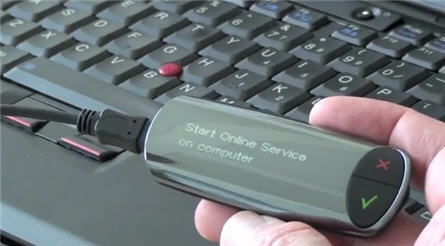
IBM’s ZTIC (Zone Trusted Information Channel) is a smart-card reader that attaches to computer via a USB cable. During an online banking transaction, it bypasses the Web browser and makes a direct connection with the bank. The connection is an industry standard SSL (Secure Sockets Layer) which enables the user to enjoy a secure link between their computer and the bank server.
What is great about the USB secure product is that a hacker could not cloak a transaction via the web and show the user a transaction of one amount, while robbing them blind with a different amount as the “actual” transaction.
What is funny about the UBS press release is the following:
If the transaction has been hacked and the account number is different, the customer can abort the payment by hitting a red “x,” or a green check if it’s fine
Well…if they knew the transaction was hacked, wouldn’t they stop it anyway?
Another nice feature of the UBS secure USB device is that a keylogger could not record keystrokes because the sync process between the user and bank happens through the UBS device, no account numbers are used or typed.
Continue Reading
CES 2010:Â Lexar announces two new drives designed as compact drives with big storage capacity.
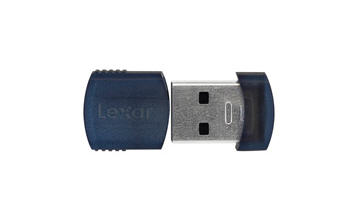
The Lexar Echo SE is the smallest Lexar drive yet at just 20.1mm x 15.1mm. It looks much like a USB dongle, but with the flash memory stored inside the USB connector. Lexar understands with the larger capacities, these little USB drives are invaluable for data backup. The Echo SE is available from 8-32GB size and includes Lexar’s automatic backups software.
The Lexar Echo SE will be available in February, but you can pre-order them now at Amazon [link here].
If the Echo SE is a bit to small, or you have trouble with holes in your pant pockets, you might opt for the larger Echo ZE drive. Here you have the sleek looking switch blade design where the USB connector retracts into the body. In addition to the backup software you also get AES 128-bit encryption software in the event you lose your Echo ZE drive.
As with the SE series, the Echo ZE will not be available until February, but you can pre order them at Amazon [link here].
Thoughts or comments? Make them on our FaceBook page.
Continue Reading
It’s been all over the blogs the last couple of days regarding Kingston and their security issues. They have been tight lipped about exactly what makes the device vulnerable and with specific information it’s hard to gauge just how hard it would be for someone to crack it.
I don’t think the typical user who keeps their personal information secure with this drive [in the event it’s lost] has much to worry about, but the government has purchased plenty of units and that’s clearly a concern. The list of drives include Data Traveler BlackBox, the Data Traveler Secure – Privacy Edition, and the Data Traveler Elite – Privacy Edition. Again, a typical computer user probably doesn’t have the tools or skills to unlock the device, but a professional would.
My guess is the IC controller chip which runs the AES 256 encryption is at fault here and someone has figured out how to hack the machine code and disable the encryption, but that’s just my educated guess being in the industry.
PC World did a good write up about the statement and interesting perspective on the whole situation.
Continue Reading
We’ve seen the first step in USB 3.0 which is the USB host controller. This gives motherboards the opportunity for USB 3.0 devices to connect. Now we are starting to see other system support peripherals such as the USB 3.0 hub.
VIA announced their USB 3.0 four port hub this week just days before CES 2010. We fully expect others to make a similar announcement during the CES show, but VIA, thus far, has beat everyone to the punch.
The USB 3.0 hub supports 4 downstream ports and one upstream port. The board is powered via AC and VIA claims to have improved the power management in the USB 3.0 hubs to allow attached devices to enter into a lower power state when not being used. The chip itself is based on advanced 80nm CMOS technology which makes it a more power efficient USB hub controller.
VIA did indicate the USB 3.0 hub is not only backward compatible, but also supports the full 5Gb/s transfer rate USB 3.0 calls for. No word on price, but I’m forecasting a 50% increase in price over traditional USB hubs.
MSN did a fun article on 8 lavish gadgets for the holidays, and of course, a USB flash drive made the list.
Gresso introduced a 64GB USB flash drive which is F1 racing inspired with sleek design, look and material. Gresso used the base material to be carbon fiber [the black] and titanium alloy as the accents [silver] then glazed the entire device with a special ceramic coating.
The Gresso branded USB stick will set you back 6,448 Peso’s or about $500 USDs. Still small enough to be lost in any coat pocket, but a perfect stocking stuffer for the well-to-do.
So the question becomes:Â would your friends be more impressed with the Gresso flash drive or a $500 bill?
Fuchi View is making our life very portable with their new Pico Projector Plus USB projector. As you can see from the picture the Pico Projector is literally the size of your hand. The dimensions are a tiny 11.5 x 6 x 2.6cm.
Although the built in memory is only 1GB making it ideal for shorter presentations, to take full advantage of the multimedia functions you can use the SD memory slot to project even the largest of multimedia files.
If you are serious about this product there here are a couple more bullet points to consider: Display formats include JPG, BMP, AVI, MOV, DivX, XviD, 3GP and MP4. Runs off AA batteries or AC adapter. Connects via mini USB cable. Screen size from a small 5 inches to a large 65 inches. Contrast ratio 260:1. Aspect ratio 4:3 and the key element of resolution being 640 x 480 RGB.
Continue Reading
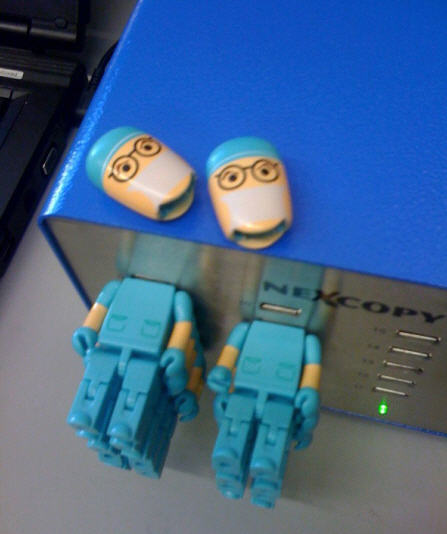
The USB surgeon is not alone, he also comes as a doctor and nurse. Unfortunately we don’t have pictures of the entire medical family but we do have the following.
First, SlipperyBrick and TechFresh reported on the drive earlier today, but we thought a “in the wild” photo would also be fun. Here is a snapshot of them multiplying before your eyes.
As SlipperyBrick pointed out, it’s a fun little drive that you can decapitate as well as play out classic MASH scenes or more current Grey’s Anatomy drama.
The USB surgeon flash drive can be found at USBGeek.com for just a shade over $20.
If we find the doctor or nurse, we’ll let you know…chances are, they are in the supply closet…no wait, that’s Scrubs.
Source:Â SlipperyBrick & TechFresh
Continue Reading
SuperTalent announce their USB 3.0 flash drive in November of 2009. Today we have a short video of that drive in action. You can see the performance of the device is much greater than any 2.0 device. How would you like to copy files at 78MB per second?
I spoke with SuperTalent last night and still no word on official price or official launch date.
You learn something new every day. Today I learned that Sony has been working on a new bio technology that reads vein structure of a human hand. The project is called “Mofiria.”
Object behind this project is taking the biometric finger reading technology one step further, and using vein structure as the authentication code [after all we have all seen movies where a fake silicon finger gets the burglars in].
So now the biometric technology is all buttoned up, Sony developed a USB vein reader that users could implement in the field.
Continue Reading
For those who need disaster recovery protocols put into place, the new ioSafe 2TB hard drive is your best friend. The USB hard drive is both water proof and fire proof making it the most durable drive on the market, and essential for disaster recovery mandates.
I can tell you one thing, seeing is believing. Check out this 2 minute video where the ioSafe is getting wet and wild and then dried off at over 1,500 degrees.
The USB hard drive ioSafe can be submersed in water for 3 days without damage to the digital content.
The ioSafe USB hard drive can withstand fire excess of 1,500 degrees for over 15 minutes without damage to the digital content. So how do they do it?Â
Continue Reading