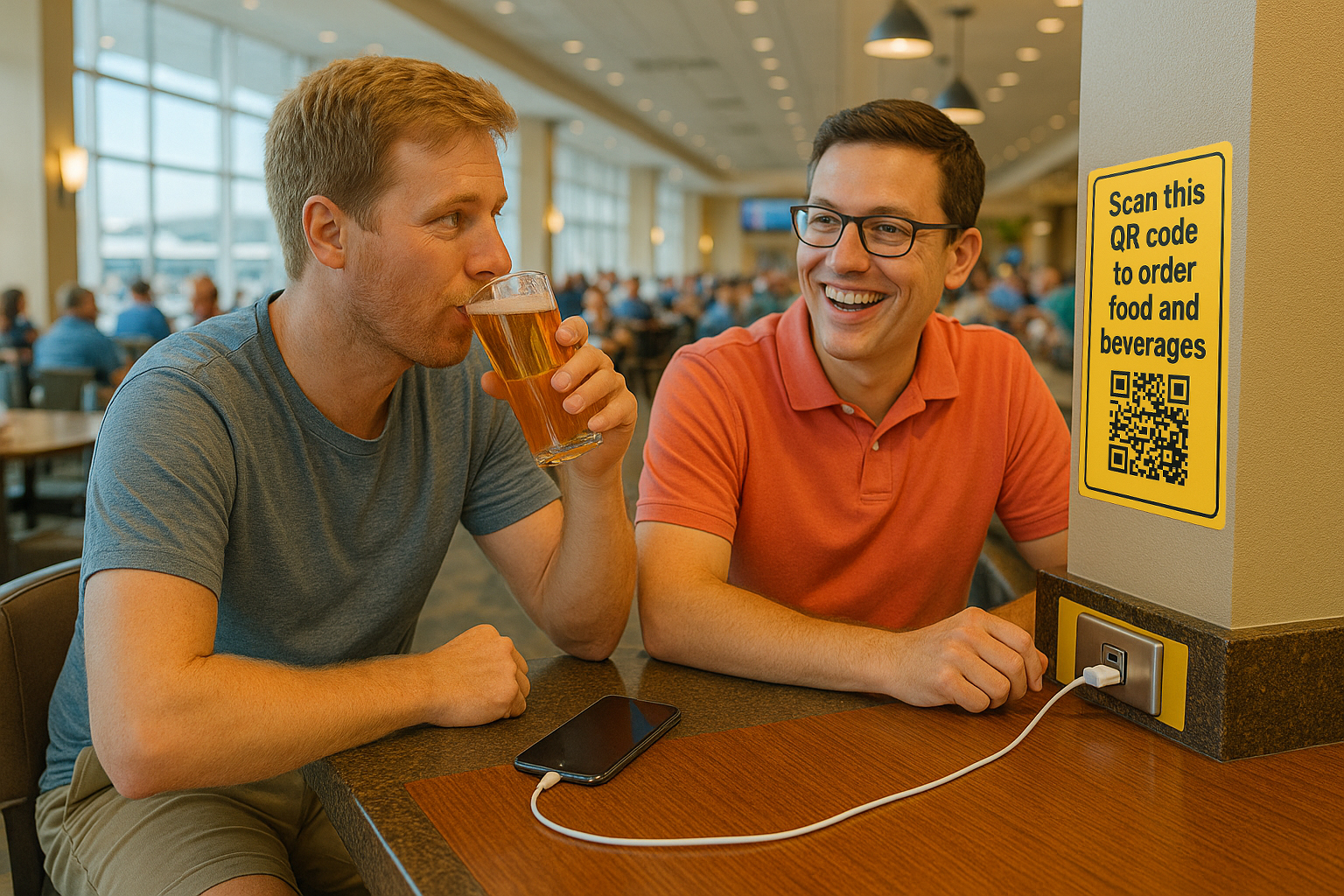
Alright, picture this.
I’m sitting in an airport lounge that smells like carpet cleaner and broken dreams, ordering a drink that’s technically a beer but priced like a mortgage payment. I haven’t even taken my first sip yet when I overhear that guy two seats over, leaning in like he’s about to reveal classified information.
“Don’t plug your phone in there,” he whispers. “They steal your data.”
I almost spit my drink.
This whole airport USB charging panic has taken on urban-legend status. It’s right up there with razor blades in Halloween candy and the idea that airlines make money off baggage fees instead of your soul. And yeah, the warning signs are everywhere now — “Avoid public USB ports,” “Use your own charger,” “Juice jacking is real.” Sounds scary. Sounds official. Sounds… mostly wrong.
Here’s the thing. Ninety-nine percent of the time, plugging your phone into an airport USB port is about as dangerous as using their Wi-Fi to check the weather. Those charging stations aren’t sitting there running some evil hacker OS waiting to suck your photos into the cloud. Most of them are power only. No data. No handshake. No funny business. The data lines — the infamous D+ and D- wires — are either clipped, shorted, or never connected in the first place. They exist purely to shove electrons into your battery and nothing more.
No data lines means no data transfer. Period. You can’t steal what isn’t electrically there. That’s not an opinion, that’s physics.
Now, could there theoretically be a rogue charging station somewhere on planet Earth that exposes full USB data and tries something clever? Sure. There are also theoretically sharks in swimming pools. Doesn’t mean you panic every time you cannonball. Modern phones are not stupid. If something fishy happens — if a port actually presents itself like a computer — your phone will immediately ask you that very un-subtle question: “Trust this computer?” That’s your red flag. That’s the bouncer tapping you on the shoulder and saying, “Hey buddy, you sure about this?”
If you don’t tap yes, nothing happens. End of story.
The real villain in this whole saga isn’t the airport wall port. It’s the mystery USB cable. The free cable.
The cable you find plugged into the outlet already, just laying there like it’s been waiting for you. That thing? That’s where the actual risk lives. A cable can hide a chip. A cable can pretend to be a keyboard. A cable can do BadUSB nonsense if someone really wanted to be malicious. And that’s why the smart move isn’t paranoia — it’s just using your own cable. The one that came from your bag, not the one that looks like it’s survived three divorces and a TSA pat-down.
So yeah, if you want to be ultra-safe, bring your wall charger. Use a charge-only cable. Carry a data blocker. Not because airports are hacking you left and right, but because it costs almost nothing to shut down the one edge case that actually matters.
But this idea that airport USB charging is some digital pickpocket waiting to rob you blind? That’s mostly fear marketing mixed with outdated tech knowledge and repeated so many times it starts to sound true. The reality is boring. And boring is good.
I finish my drink, unplug my phone from the lounge charger — battery now happily climbing — and walk past the warning sign on the wall telling me to beware of juice jacking. I smile. Not because I’m reckless, but because I know how the wires actually work.
And that, my friends, is the difference between being scared of USB ports… and understanding them.