A practical look at battery life, power delivery, and why USB charging changes the equation.
AA and AAA batteries quietly power a surprising amount of modern life. From TV remotes and flashlights to wireless keyboards, toys, and test equipment, these small cells sit behind countless everyday tasks. For decades, disposable alkaline batteries were the default choice. You bought a pack, used them until they died, then tossed them in a drawer or the trash and bought more.
That habit made sense when rechargeables were inconvenient, slow, and unreliable. But that era is over. Today’s rechargeable AA and AAA batteries — especially those that charge directly over USB — have fundamentally changed how practical reusable power can be.
To understand why, it helps to break the discussion into two parts: the difference between AA and AAA sizes, and the difference between disposable and rechargeable chemistry.
AA and AAA batteries share the same basic voltage class, but they are not equal. AA batteries are physically larger, which means they can store more energy. A typical AA disposable battery can hold roughly two to three times the capacity of a AAA battery. In real terms, this means an AA battery usually lasts much longer than a AAA battery in the same type of device.
Voltage, however, tells only part of the story. Disposable alkaline batteries start at about 1.5 volts, but their voltage steadily drops as they discharge. Rechargeable NiMH batteries are rated at about 1.2 volts, which sounds worse on paper but behaves very differently in practice. Rechargeables tend to deliver steadier voltage for most of their discharge cycle, while alkalines slowly fade.
This difference matters because many modern devices care more about voltage stability than peak voltage. A rechargeable battery may appear “weaker” by the numbers, but in moderate- to high-drain devices, it often delivers more usable energy before the device shuts down.
Battery chemistry also affects how a cell performs under load. Disposable alkaline batteries suffer from higher internal resistance, which means their effective capacity drops sharply in high-drain situations like digital cameras, flashlights, toys, and wireless gaming controllers. Rechargeable batteries handle these loads far better, maintaining output without the dramatic performance drop seen in disposables.
The result is a counterintuitive reality: in many real-world devices, rechargeable batteries can last as long as — or longer than — disposable batteries per use cycle, even if the rated capacity appears lower on the label.
The real advantage, however, shows up over time. Disposable batteries are single-use by design. Rechargeable batteries can typically be reused hundreds of times, and in some cases over a thousand charge cycles before noticeable degradation. Even when accounting for the cost of a charger, rechargeables almost always win on total cost after just a handful of replacements.
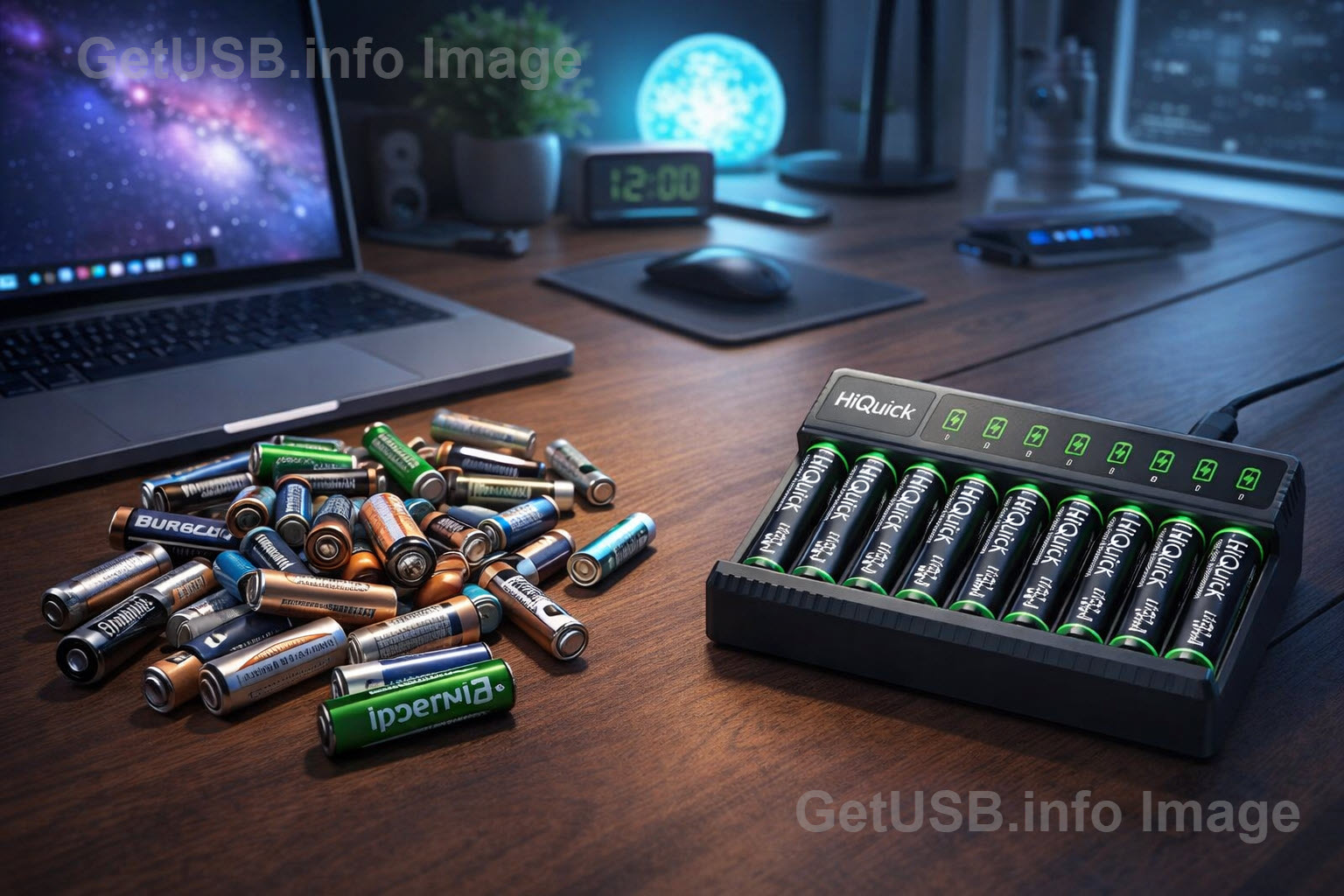
USB-rechargeable batteries push this advantage even further. Instead of requiring a dedicated charging cradle, these batteries plug directly into USB-A or USB-C ports. That means you can recharge them using the same cables and power sources you already use for phones, laptops, power banks, and wall adapters. No special charger, no proprietary dock, no extra hardware to manage.
Shelf life is one area where disposable batteries still have a niche advantage. Alkaline batteries can sit unused for many years and still retain much of their charge, which makes them useful for emergency kits or rarely used devices. Rechargeable batteries slowly self-discharge over time, although modern low-self-discharge designs have greatly reduced this issue.
From an environmental perspective, the difference is hard to ignore. A single rechargeable battery can replace hundreds of disposable cells over its lifetime. That translates to less manufacturing, less transport, and dramatically less waste.
The practical trade-offs between disposable and rechargeable batteries can be summarized clearly:
- Disposable batteries offer higher initial voltage and long shelf life, but perform poorly under high drain, cost more over time, and create ongoing waste.
- Rechargeable batteries provide steadier power delivery, better performance in demanding devices, far lower long-term cost, and significantly reduced environmental impact — especially when USB charging removes the inconvenience barrier.
For clarity, here is a simple side-by-side comparison:
| Feature | Disposable AA / AAA | Rechargeable AA / AAA |
|---|---|---|
| Nominal Voltage | 1.5 V | 1.2 V (regulated 1.5 V on some USB models) |
| Performance Under Load | Drops quickly in high-drain devices | Stable output, better for high-drain use |
| Usable Runtime | Good for low-drain devices | Often equal or better in real-world use |
| Recharge Cycles | Single use | Hundreds to 1,000+ cycles |
| Long-Term Cost | Higher over time | Lower after repeated reuse |
| Convenience | No charging required | USB charging removes need for a dock |
| Environmental Impact | High waste | Significantly reduced waste |
When viewed through a modern USB-powered lens, the conclusion becomes hard to avoid. Rechargeable AA and AAA batteries are no longer a compromise or niche solution. With USB charging, they integrate seamlessly into the same power ecosystem that already runs phones, tablets, and laptops.
For devices used regularly, rechargeable batteries are almost always the better solution — more economical, more consistent under load, and far less wasteful. Disposable batteries still have a place for emergency storage or infrequently used gear, but they are no longer the default choice they once were.
If you are curious to explore USB-rechargeable AA and AAA batteries, you can see a representative example here:
View USB-Rechargeable AA & AAA Batteries on Amazon
Put simply, once batteries become just another USB-charged device, the old disposable model starts to feel outdated.