Scientists are experimenting with biological systems as a new medium for long-term data storage
Every few years, someone declares that we’re “running out of storage.” Scientists tend to respond the same way every time: Fine — we’ll just store data in glass… or DNA… or a living brain.
And no, they’re not joking.
Once you step outside the familiar world of silicon and NAND flash, data storage stops looking like chips and circuit boards and starts looking like something pulled from a biology lab, a physics experiment, or a science-fiction novel. What’s striking is that none of this is theoretical hand-waving. In one form or another, every idea you’re about to read has already been demonstrated in real labs—often working far better than intuition would suggest.
Let’s start with one of the least intuitive ideas that, once you sit with it, actually makes a lot of sense: DNA.
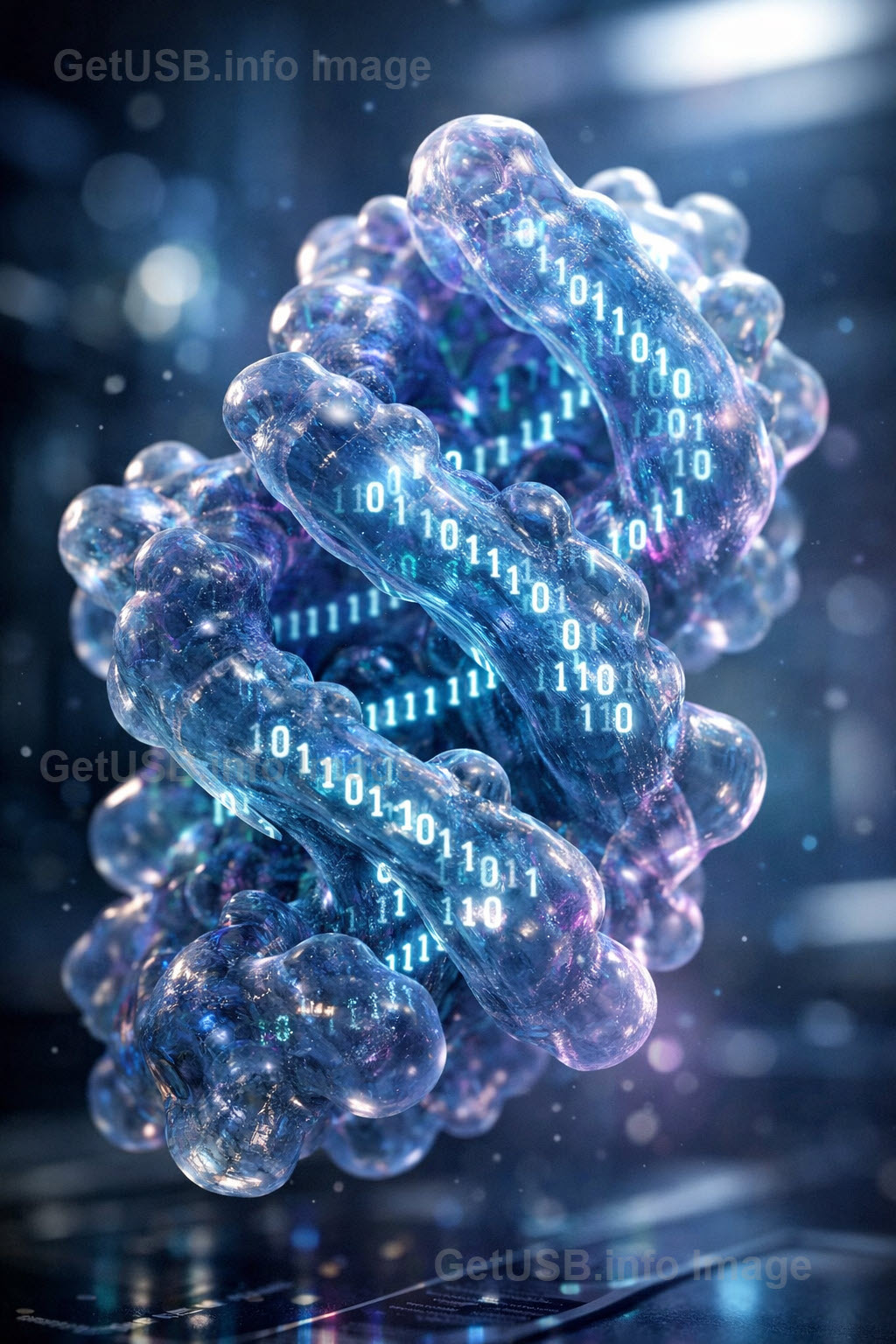
DNA already stores information. That’s literally its job. Every cell in your body carries a complete instruction manual for building you, written in a four-letter code. Scientists eventually realized that if biology can store that much information so densely and reliably, maybe we can piggyback on the same system.
By translating binary data into combinations of A, C, G, and T, researchers have already stored books, images, movies, and even entire operating systems inside synthetic DNA strands. The density is absurd. A single gram of DNA could theoretically hold hundreds of petabytes of data. Stored correctly, it could last thousands of years.
The catch, of course, is speed. Writing and reading DNA is slow and expensive, so this isn’t replacing your SSD anytime soon. But as a long-term archive, DNA starts to look less like a novelty and more like a biological vault.
Once you accept that molecules themselves can store data, proteins are the next logical step—and this is where things start getting strange.
Proteins don’t just sit there; they fold. The exact way a protein folds determines how it behaves, and in some cases, that folding can change in stable, repeatable ways. Scientists have engineered proteins that flip between multiple shapes, with each shape representing a different data state. In effect, a single molecule becomes a microscopic switch.
Cells already use this trick to “remember” past signals, so researchers are essentially hijacking biology’s own memory system. This idea isn’t even new. Nearly two decades ago, experiments were already showing how biological proteins could be used to store staggering amounts of data, long before “bio-storage” became a buzzword.
It works, but it’s fragile. Temperature, chemistry, and time all interfere. Still, the notion that information can be stored in the way a molecule curls up on itself is one of those ideas that tends to stick in your brain.
If biology feels a little too squishy, physics has an answer—and it comes in the form of glass.
Not the kind in your windows, but ultra-pure glass written with femtosecond lasers. These lasers create tiny nanostructures inside the glass, and data is encoded not just by position, but by depth, orientation, and size. That combination is where the term “5D storage” comes from.
The result is memory that can survive extreme heat, radiation, and time scales measured in billions of years. In theory, you could store humanity’s knowledge in a glass disc, lock it in a vault, and come back long after everything else has failed. Reading and writing are slow and require specialized optics, but as an archival medium, glass might outlast civilization itself.
Then there’s the idea that makes people pause and ask uncomfortable questions: living memory.
Neurons store information naturally by strengthening or weakening their connections to one another. Researchers have grown clusters of neurons—sometimes called mini-brains or organoids—and observed that they can learn, adapt, and respond to training. Some experiments have even shown neuron cultures playing simple games or recognizing patterns.
This isn’t storage in the “save file to disk” sense, but it is memory in the most literal biological form. And the moment you realize that, the ethical alarms start ringing.
If biology feels messy, scientists go even smaller—all the way down to individual atoms.
In a now-famous experiment, IBM researchers used a scanning tunneling microscope to position single atoms on a surface, with each atom representing a bit. This is about as dense as storage can possibly get, simply because there’s nothing smaller than an atom to work with. Closely related is quantum memory, where information lives in fragile quantum states instead of physical positions.
These approaches work, but only under extreme conditions: ultra-high vacuum, temperatures near absolute zero, and equipment that looks more like a physics cathedral than a computer.
Somewhere between physics and engineering sits spintronics, which flips the script on how electronics behave. Instead of storing data as electrical charge, these systems encode information in the spin of electrons or in exotic magnetic structures with names that sound fictional, like skyrmions. The upside is persistence—the data doesn’t disappear when power is removed—and dramatically lower energy requirements.
And then there are the ideas that feel like chemistry class gone rogue.
Certain chemical reactions can maintain stable states, oscillate, or form repeating patterns. Researchers have experimented with using those states to represent information. In some cases, memory exists as a color, a wave, or a chemical balance. No circuits. No transistors. Just reactions remembering where they’ve been.
Finally, there are materials that sit quietly between all of this madness and the technology we already know. Phase-change memory uses substances that switch between crystalline and amorphous states, with each state representing data. If you want a grounding point for how today’s flash memory connects to these ideas, understanding how SLC flash works helps bridge the gap between conventional storage and these more exotic approaches.
Step back and a pattern emerges. Scientists are chasing three things: extreme density, extreme longevity, and adaptability. Silicon excels at speed and cost, which is why it dominates today. But when the goal shifts to storing data for centuries, surviving disasters, or mimicking how memory works in nature, the solutions stop looking like chips and start looking like glass, molecules, and living cells.
The future of storage may not be a faster USB stick. It might be a strand of DNA in a freezer, a crystal etched with light, or something alive that remembers because it learned—not because it was written to.
And honestly, that’s a pretty great way to end a Fun Friday.