For years we’ve been told that hard drives fail, tape must be refreshed, and flash memory slowly forgets. Then along comes a headline claiming scientists have invented a glass storage medium that could preserve data for 10,000 years. That sounds dramatic. It also sounds like marketing. So instead of repeating the headline, let’s walk through the actual questions that matter — the same questions that came up in conversation. Because if this technology is real, the implications are technical, economic, and philosophical all at once.
Storage evolution has always been a story of compression and durability. From magnetic drums to modern NAND flash, capacity has exploded while physical footprint shrank. If you zoom out far enough, the trajectory becomes obvious — which I broke down in this review of digital storage capacity from 1956 to today. Project Silica doesn’t just extend that curve. It attempts to bend it into geological time.
Who started this and why did they start it?
The work began inside Microsoft Research around 2016 as part of what became known as Project Silica. The driving force was not science fiction ambition; it was Azure. Hyperscale cloud storage providers face a long-term archival problem. Magnetic tape works well, but it requires migration cycles. Hard drives degrade. NAND flash leaks charge over time. At hyperscale, refresh cycles become operational overhead measured in millions of dollars.
The motivation was straightforward: build a storage medium that does not require periodic rewriting to maintain integrity. In other words, defeat retention drift at the physical level. Instead of storing bits as magnetized domains or trapped electrons, the research team explored structural encoding inside fused quartz.
- Reduce migration cycles in cold archive storage
- Eliminate charge leakage and magnetic decay
- Create a passive medium that requires no power to preserve data
- Integrate eventually into Azure cold tier infrastructure
Does silica melt down with high heat?
Yes, silica melts. But not in the way most people imagine. Project Silica uses fused quartz, which has a melting point around 1,600–1,700°C. That is significantly higher than typical building fires, wildfires, or even lava exposure. The widely quoted “10,000 years at 290°C” is an accelerated aging test — not a required operating temperature.
Heat accelerates material degradation. If the structure survives thousands of years at 290°C continuously, then at room temperature the theoretical lifespan becomes geological. That does not make it indestructible. It can shatter. It can be crushed. But thermal decay is not the primary vulnerability.
For comparison, most everyday storage media is nowhere near that stable. NAND flash experiences charge leakage and controller failure over time, which is something I covered in detail when explaining how long a USB flash drive actually lasts. Silica storage isn’t competing with flash drives — it’s playing in a completely different time category.
- Melting point ~1,600–1,700°C
- Typical structural fires peak below that threshold
- Durability claim refers to retention stability, not invincibility
- Mechanical fracture remains the most realistic threat
Did they invent a device to read it back?
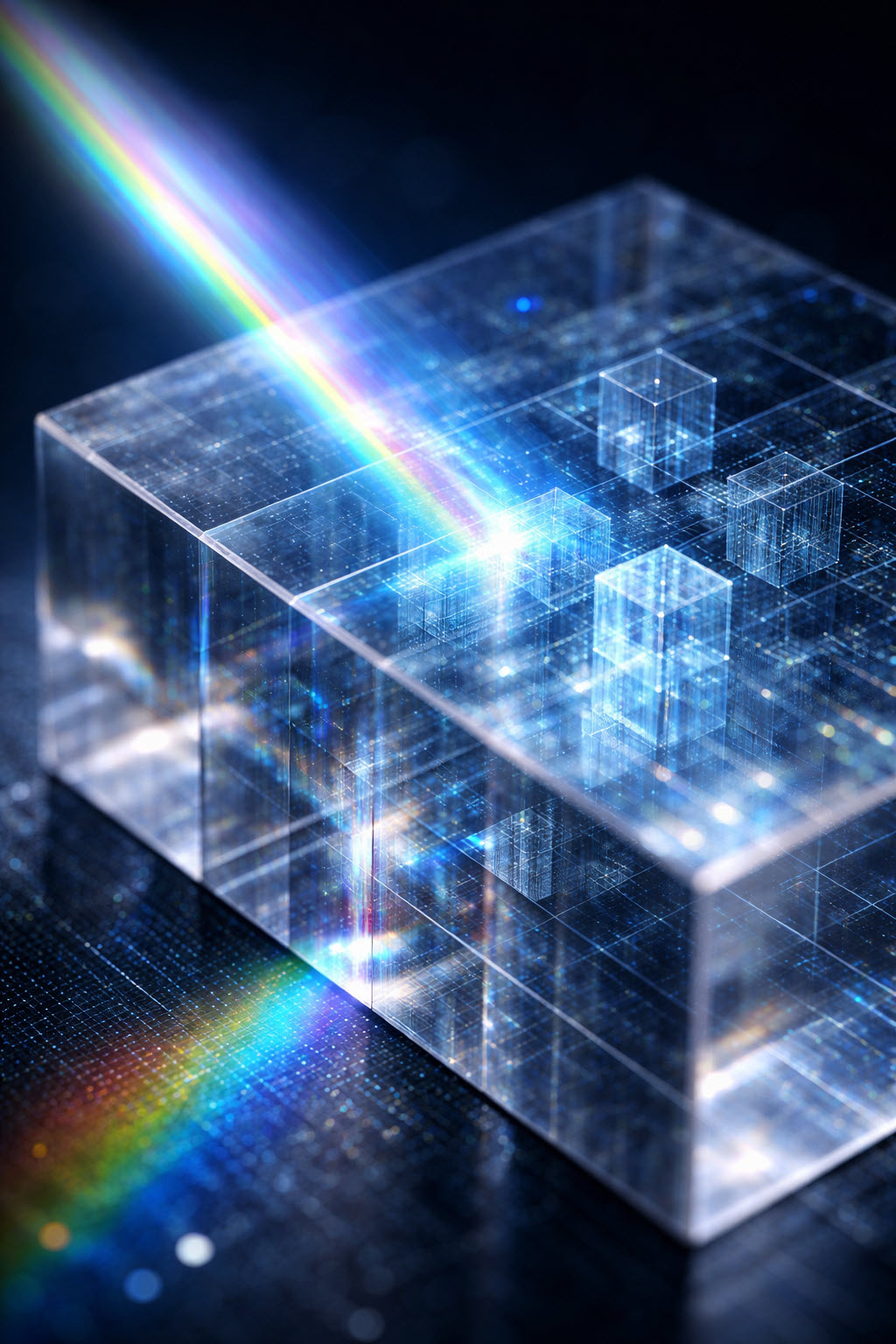
You do not put this into a DVD player. The system requires a dedicated optical reader. Data is written using a femtosecond laser that creates microscopic three-dimensional structures — voxels — inside the glass. Those structures alter how polarized light passes through the material.
Reading involves polarized illumination, high-resolution imaging, and machine-learning-assisted decoding. The medium is passive; the intelligence resides in the reader. That means the archive is durable, but the ecosystem around it must also persist.
- Femtosecond laser for voxel creation
- Polarization-sensitive microscopy for readback
- Machine learning to decode optical states into binary
- No compatibility with consumer optical drives
What exactly is a voxel, and does light angle represent binary?
A voxel is a volumetric pixel — a tiny 3D unit inside the glass. The laser modifies the internal structure to create birefringence, meaning light passing through that point changes polarization and phase. Each voxel does not simply represent a 0 or 1. Instead, measurable optical states are mapped back into binary by software.
Because multiple properties can be encoded — orientation, strength of retardance, spatial depth — each voxel can store multiple bits. This is how density surpasses traditional optical media. It is geometry as data. Not charge. Not magnetism. Structure.
- 3D spatial encoding (X, Y, Z)
- Birefringent nanostructure formation
- Optical phase and polarization measurement
- Software mapping of optical state to binary values
How much could fit on a DVD-sized glass disc?
Demonstrations have shown 4.84 TB stored in a 12 cm square, 2 mm thick glass plate. A DVD disc is 12 cm in diameter, slightly smaller in surface area. Proportionally, a disc of similar thickness could hold roughly 3.7–4 TB using current demonstrated densities.
That is approximately forty times the capacity of Blu-ray in a similar physical footprint. The limitation is not surface area alone; it is voxel spacing, write precision, and decoding fidelity.
- Demonstrated density: ~4.84 TB per 144 cm²
- DVD surface area: ~113 cm²
- Estimated proportional capacity: ~4 TB
- Future density dependent on voxel refinement
How long would it take to write 4 TB?
Here is where the excitement cools down. Writing is slow. Current experimental write rates are measured in gigabits per minute, not gigabytes per second. A multi-terabyte write operation could take days under present lab conditions.
This is not a consumer backup solution. It is more analogous to sculpting data into glass at nanoscale precision. Throughput improvements may come from parallel lasers and better motion control, but even optimistic projections suggest archival-scale speeds, not SSD speeds.
- Serial voxel-by-voxel laser writing
- Precision positioning requirements
- Potential multi-day write cycles for multi-terabyte volumes
- Optimized for permanence, not speed
What kinds of data justify this level of archival permanence?
Cold tier storage is rarely accessed but operationally critical. Think national archives, climate research datasets, legal records with multi-decade retention mandates, cultural media masters, and scientific telemetry that cannot be reproduced. Tape already serves this role effectively, but glass attempts to remove refresh cycles from the equation.
The qualification criteria are simple: irreplaceable, long retention requirement, and low access frequency. Not everything deserves to live for 10,000 years. But some datasets arguably do.
- Government and constitutional records
- Climate and genomic research data
- Media masters and historical archives
- Long-term compliance and legal evidence storage
Is this about protecting data from time or from humanity?
Technically, it is about time. Magnetic fields drift. Charges leak. Geometry remains stable. From an engineering standpoint, this is entropy mitigation.
But permanence changes context. Historically, storage fragility allowed societies to forget. Permanent digital retention challenges that pattern. Who controls access in 200 years? Who maintains reader compatibility? Durability is not the same as neutrality.
Glass is not the only radical archival experiment underway. Researchers are also exploring entirely different biological substrates for preservation, which I discussed in this look at storing data in living protein. When you compare protein encoding with laser-written silica, one thing becomes clear: the future of archival storage will not resemble spinning disks or USB sticks.
- Designed to prevent physical retention decay
- Does not prevent deliberate destruction
- Introduces long-horizon governance questions
- Shifts archival control toward infrastructure providers
Experience & Perspective
This article was created with AI-assisted research structuring and technical cross-referencing, then reviewed and refined by Matt LaBoff, USB Storage Systems & Duplication Specialist with over two decades of experience in flash memory, archival media, and data integrity workflows. The analysis reflects hands-on industry knowledge combined with publicly available research disclosures.