
Digital Storage Capacity in 1956, Now in 2022 and Future 2087
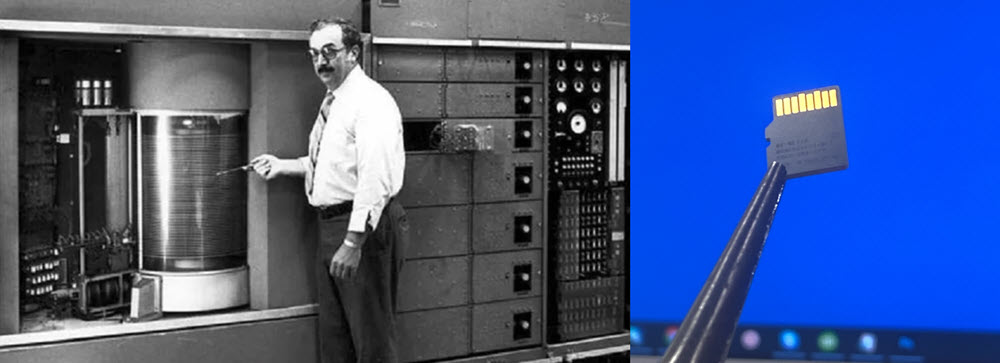
IBM introduced the world’s first commercial storage system, the 305 RAMAC, in 1956. A magnetic disk was used to store data and was intended for a secondary storage system. RAMAC stands for Random Access Method of Accounting and Control and was designed for real-world accounting needs in business. The first customer was the US Navy.
The physical size of the 305 was 6 feet wide by 5 feet deep. Total storage capacity was 4.4 MB (megabytes). The weight for this storage system was just over one ton (source).
Today (2022), we can see a 1TB (terabyte) microSD card (TF card) at the small size of 15 mm x 11 mm and a weight under one gram.
The big selling point from IBM in 1956 was the ability for the 305 to store the equivalent of 64,000 punch cards on its magnetic disks. Punch cards are stiff pieces of paper which contain digital data represented by the presence (or absence) of holes in predefined positions on the card.
The IBM 350 disk system could store 5 million alphanumeric characters as six data bits, one parity bit, and one space bit, for a total of eight bits per character. It had fifty disks with a diameter of 24 inches. Under servo control, two independent access arms moved up and down to select a disk and in and out to select a recording track.
In comparison, today’s 1TB microSD card will hold about 6.5 million documents. Said another way, that is roughly equivalent to about 1,300 filing cabinets of documents.
In 1957, IBM would lease the RAMAC 305 for about $3,200 per month (roughly $33,000 in 2022 dollars). Over one thousand 305 systems were manufactured before production ceased in 1961.
Digital Storage in the Future
If we consider Moore’s Law, where storage capacity and technology in general double every 18 months, we can calculate 43 cycles of Moore’s Law between today and 65 years into the future. Doing some advanced math, we estimate the storage capacity of a microSD card, if still available, in 2087 would be 18,446,744,073,709,600,000,000,000 TB of data.
Tags: digital storage capacity, future, now, past
